


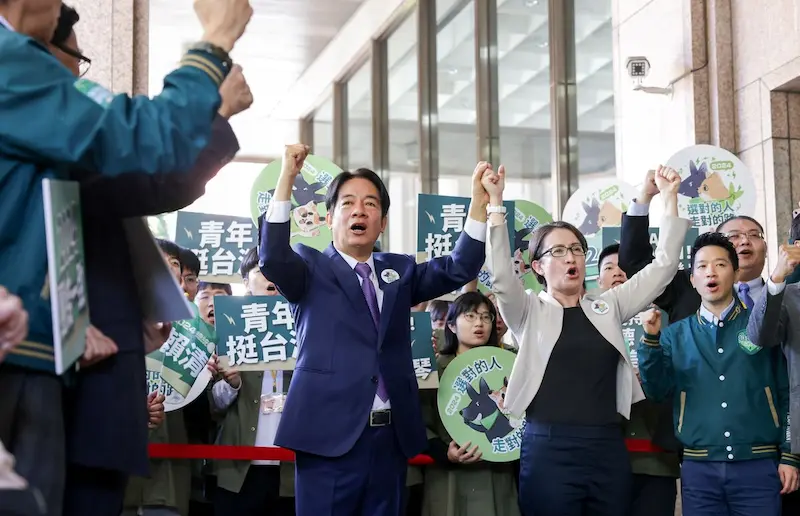


In a surprising turn of events, Taiwan's most pro-US candidate has emerged as the frontrunner in the upcoming presidential election, providing a clearer path to victory. Vice President Lai Ching-te, the candidate from the ruling Democratic Progressive Party, has maintained a steady lead in the polls throughout the year. However, a highly anticipated alliance between the main opposition parties threatened to challenge his position.
The unity ticket between the Kuomintang's Hou Yu-ih and the Taiwan People's Party's Ko Wen-je suffered a spectacular collapse during a press conference, where the two leaders had a public falling out. Consequently, both men filed rival bids, effectively splitting the Beijing-friendly vote shortly before the deadline. This turn of events is likely to disappoint Chinese President Xi Jinping, who has criticized Lai for his stance on cross-strait relations.
The failure of the joint ticket puts Lai in a stronger position, which could frustrate Beijing's plans for Taiwan. A government in Taipei that is more open to restarting talks with Beijing would reduce the need for Xi to intensify pressure on the island and potentially strain China's relations with the United States. The Biden administration already has strong ties with Taiwan's ruling party and has pledged significant support to bolster Taiwan's military capabilities. A continuation of the DPP government would likely result in a smooth transition and further cooperation with the US.
The collapse of the alliance also adds pressure on Lai's campaign. Beijing is expected to increase its efforts to prevent Lai from making any provocative statements or actions that cross its "red lines." China has branded Lai a "troublemaker" seeking Taiwan's independence and has accused him of lying about maintaining the peaceful status quo. The Chinese government fears that Lai's leadership could potentially lead to war on the island.
This week has witnessed a dramatic series of events that have altered the political landscape in Taiwan. The alliance between the KMT and TPP, aimed at unifying the opposition, quickly unraveled during a public exchange of insults between Hou and Ko at a press conference. The discord was so intense that former President Ma Ying-jeou, a member of the KMT, chose not to speak, symbolically refusing to engage in the mudslinging. This chaotic moment has left a lasting impression in Taiwan's political history and may hinder the prospects of both Hou and Ko with voters.
The market reaction to the failed alliance has been relatively muted, with the Taiwan dollar slipping slightly against the US dollar. While the failed ticket may have some implications for Taiwan's currency and economy, the response thus far has been subdued. However, the tensions between the ruling DPP and the Communist Party in China remain a significant concern. The DPP insists on equal talks with China, while the KMT supports dialogue under the premise that Taiwan is part of China. This fundamental difference poses a challenge to closer ties between the two sides.
The United States and China both have their reasons to want to avoid escalating tensions in Taiwan. President Xi aims to stabilize Beijing's geopolitical relationships and stimulate economic growth. Any instability in the Taiwan Strait poses risks for investors, creating a barrier to investing in the world's second-largest economy. On the other hand, President Biden, facing an election year in 2024, would prefer to reduce instability and prevent any further escalation of tensions around Taiwan. As a result, Washington will closely monitor Lai's ability to maintain stable cross-strait relations and garner support internally and externally.