


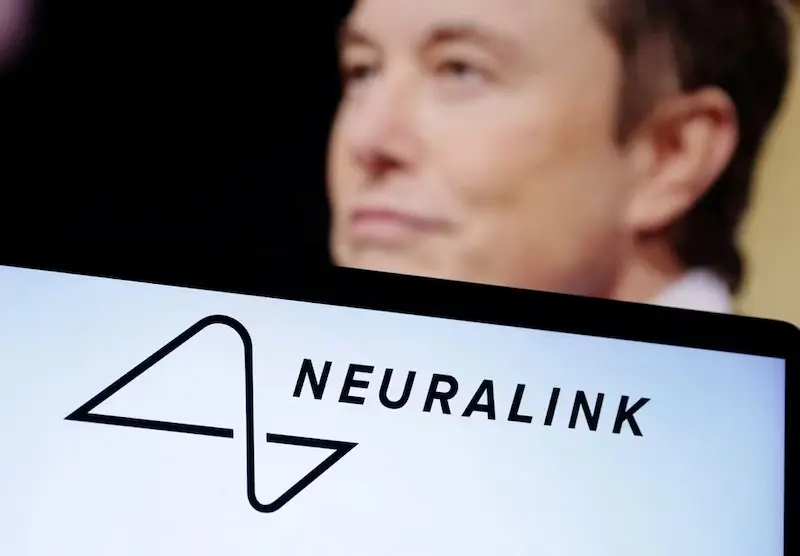


Brain-chip startup Neuralink, founded by billionaire Elon Musk, has successfully implanted its groundbreaking technology in the first human patient. Musk announced on Monday that the initial results show promising neuron spike detection, indicating that the implant is functioning effectively. Neurons, which are cells that transmit information using electrical and chemical signals, play a crucial role in the brain and body's communication network.
Neuralink received clearance from the U.S. Food and Drug Administration (FDA) last year to conduct its first trial on humans, marking a significant milestone for the company's mission to address paralysis and various neurological conditions. The startup had already obtained approval in September to recruit participants for the trial. As part of the study, a robot is used to surgically place a brain-computer interface (BCI) implant in the brain region responsible for movement intention. The primary objective is to enable individuals to control a computer cursor or keyboard using their thoughts alone.
The implant utilizes "ultra-fine" threads to transmit signals within the participants' brains, according to Neuralink. The company has also stated that its first product, named Telepathy, will be developed based on this technology. While further details regarding the implant and trial were not immediately available, Neuralink's wireless brain-computer interface is currently undergoing evaluation for safety, along with the accompanying surgical robot, through the PRIME Study.
Safety concerns have been raised about Neuralink's technology, prompting scrutiny of its protocols. Earlier this month, Reuters reported that the company had been fined for violating U.S. Department of Transportation rules related to the transportation of hazardous materials. Furthermore, four lawmakers urged the U.S. Securities and Exchange Commission in November to investigate whether Musk had misled investors about the safety of Neuralink's technology. This came after veterinary records indicated issues with the implants in monkeys, including paralysis, seizures, and brain swelling.
In response to the concerns, Musk clarified in a social media post that no monkey had died from a Neuralink implant. He mentioned that the company had intentionally chosen monkeys with terminal conditions to minimize risks to healthy ones. While the scrutiny may have raised questions about the safety of Neuralink's technology, the successful implantation in the first human patient demonstrates progress towards achieving the startup's ambitious goals.
Neuralink, valued at approximately $5 billion in June 2020, aims to revolutionize the field of neurotechnology. With its brain-chip technology, the company aspires to unlock new possibilities in addressing paralysis and neurological disorders, ultimately providing individuals with enhanced control over their own bodies and the ability to interact with technology using their minds.