


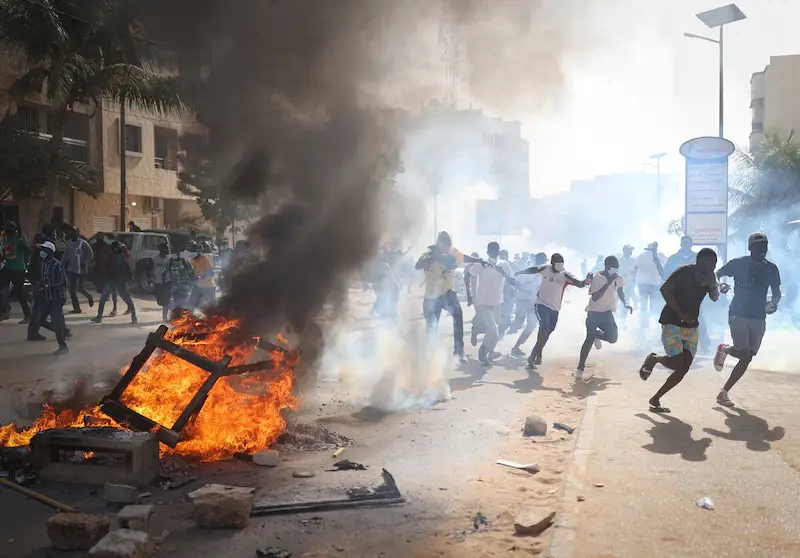


Senegal, known as one of the most stable democracies in West Africa, is now facing a constitutional crisis as lawmakers voted to postpone elections and extend President Macky Sall's final term for nearly a year. This move has been labeled by opponents as a "constitutional coup" and has cast a shadow over the country's reputation. With recent actions including the detention of presidential candidates, arrests of opposition lawmakers, and a nationwide mobile internet blackout, the situation in Senegal is becoming increasingly volatile.
The decision to delay presidential elections from February 25 to December 15 was made during a parliamentary session where opposition lawmakers were forcefully removed from the chambers after attempting to block the proceedings. This means that President Sall, whose second and final term was supposed to end on April 2, will remain in office until a successor is in power. The extension of his term has sparked widespread condemnation and concerns over the erosion of democratic principles.
The reason cited by President Sall for the election delay is a dispute at the Constitutional Council, the judicial body responsible for determining the eligibility of candidates. The council disqualified an opposition candidate, leading to allegations of corruption and challenges by other candidates. President Sall claims that a parliamentary inquiry must be conducted before elections can take place. However, opposition leader Yassine Fall has described the situation as President Sall "putting the country on a dangerous path."
The international community has expressed its concerns over the decision. The US and the Economic Community of West African States have called for the delay to be reversed, while France and the African Union have urged swift elections. Notably, this political uncertainty has also rattled investors, causing a decline in Senegal's eurobonds and raising concerns about capital inflows and investor confidence.
Senegal has long been viewed as a beacon of stability in the region, with peaceful transitions of power since gaining independence. However, since the arrest of opposition leader Ousmane Sonko in 2021, the country has witnessed sporadic and increasingly violent protests. Sonko's party was dissolved, and authorities have been accused of targeting his supporters. The current state of affairs is a stark contrast to 2012 when President Sall came to power on a wave of discontent against a president attempting an unconstitutional third term. Remarkably, Sall himself considered running for a third term last year before stepping back and endorsing a successor. Karim Wade, the disqualified presidential candidate, is the son of the former president and has also accused the Constitutional Council of corruption.
This crisis in Senegal adds to the wider instability in West Africa, with military takeovers and attempted coups becoming all too common. Mali, Guinea, Niger, and Burkina Faso are all under military rule, and efforts to restore democracy have faced setbacks. The recent announcement by these juntas to leave the Economic Community of West African States further hinders regional stability. Critics argue that the bloc has been unable to stabilize the region due to the presence of authoritarian civilian regimes that do not adhere to democratic ideals.
President Sall, who has previously played a key role in efforts to restore democracy, may have to step back from this role due to the current crisis. His actions have raised concerns about Senegal's reputation as a good democracy and may impact the country's oil and gas ambitions. Senegal, on the verge of becoming a significant producer in the industry, has secured significant investments and loans. However, the political turmoil and uncertainty may deter potential partners and hinder economic growth.
The situation in Senegal is a cause for alarm, not only within the country but also in the wider West African region. It is crucial for democratic norms and stability to be upheld, and international pressure must be exerted to ensure the timely and fair conduct of elections. The resolution of this crisis will be vital for Senegal's reputation, its citizens, and the future of democracy in the region.