


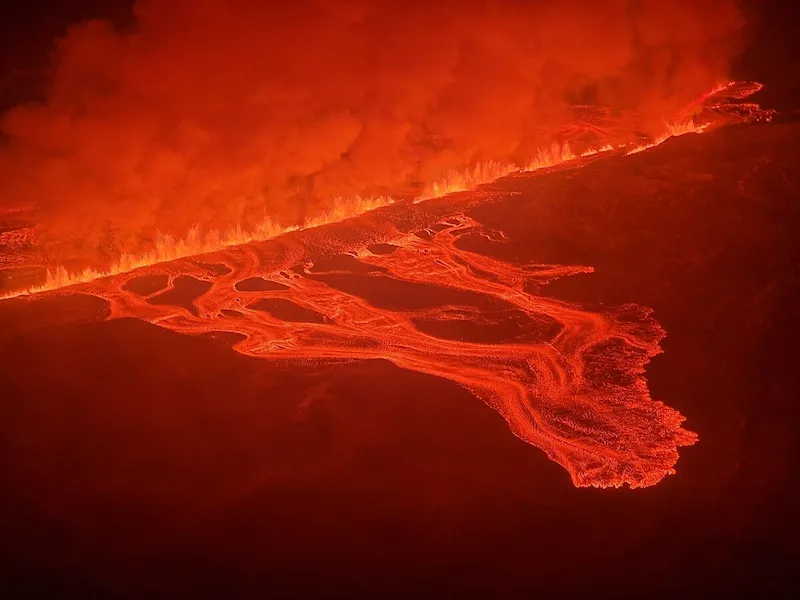


In a concerning turn of events, a volcanic eruption has once again erupted in Iceland, this time in close proximity to the already severely damaged fishing town and popular tourist attraction, the Blue Lagoon spa. This marks the third eruption in recent months on the Reykjanes peninsula, located about 40 kilometers from the country's capital.
According to the Iceland Met Office, the eruption commenced at approximately 6 a.m. local time northeast of the Blue Lagoon, causing lava to burst out from a 3-kilometer-long crack. The molten rock flow has already cut off a major road and severed a hot water pipe that supplies the peninsula's 30,000 residents.
Fortunately, the current lava flows have directed away from Grindavik, a town that has already suffered severe damage due to previous volcanic activity and seismic events. However, the infrastructure further north, including the well-known Svartsengi power plant and the Blue Lagoon, remains at risk.
As a precautionary measure, hotels located near the Blue Lagoon spa have been evacuated overnight. Other vital infrastructure in the region, such as the HS Orka hf power plant and various geothermal heat and power businesses, also face potential disruption. Earth barriers have been constructed to safeguard these areas from the encroaching lava.
Utility company HS Veitur hf is working expeditiously to lay a replacement hot water pipe for the affected area, but completion may take a few days. Meanwhile, flights in and out of the country continue to operate normally and are not expected to be impacted by the ongoing volcanic activity.
The Reykjanes peninsula, which had laid dormant for approximately 800 years, was jolted back to life in 2020 with increased seismic activity. Since then, including the present eruption, there have been a total of six volcanic incidents. The initial three eruptions that occurred in 2021 took place in uninhabited areas, posing minimal risk to people and infrastructure.
Iceland's geological makeup, situated between the North American and Eurasian tectonic plates on the mid-Atlantic ridge, contributes to its high level of geothermal activity. With around 30 volcanic systems and over 600 hot springs, Iceland is one of the most geologically active places on Earth.
The destruction experienced in Grindavik represents the most significant volcanic damage in Iceland in the last 50 years. While most eruptions typically occur in uninhabited wilderness areas, in 1973, a portion of the Westman Islands, a fishing town with a population of 5,000, was engulfed by lava.
Fortunately, as the current eruption is a fissure eruption on land, it is unlikely to produce significant amounts of ash or disrupt air travel as previous eruptions have done. The most notable disruption in recent Icelandic history took place in 2010 when the Eyjafjallajokull volcano spewed a massive ash plume, grounding air traffic across Europe for weeks and affecting millions of people.
Heading into an era of erratic volcanic activity that is difficult to predict but expected to persist for years, scientists at the Met Office have cautioned the residents and authorities of Iceland. As the country deals with the repercussions of yet another eruption, efforts to protect infrastructure and ensure public safety remain paramount.