


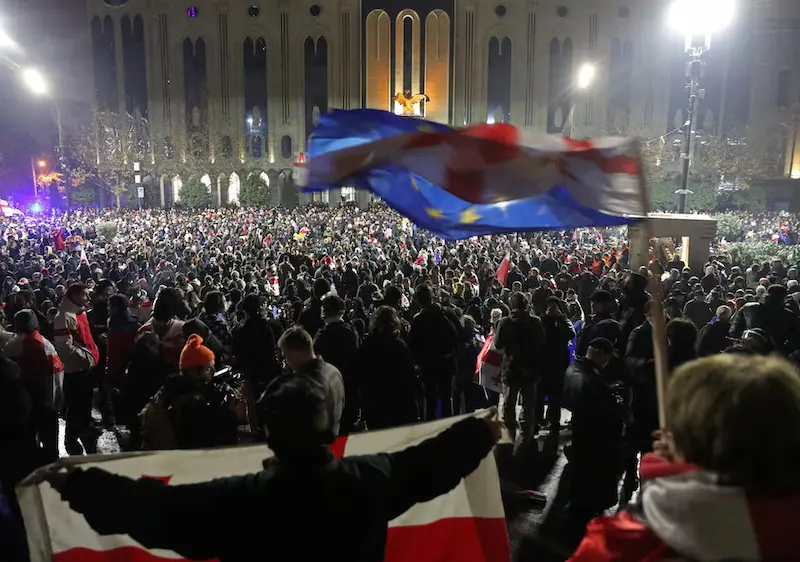


In a bold move that has plunged Georgia into a political crisis, President Salome Zourabichvili stood defiant against Prime Minister Irakli Kobakhidze on Saturday, declaring the government illegitimate and refusing to vacate her position when her term ends next month. The country, known for its aspiration to join the European Union, was rocked by the sudden decision of the ruling Georgian Dream party to halt EU accession talks for the next four years, citing alleged EU "blackmail".
Zourabichvili, critical of Georgian Dream's anti-EU stance, challenged the legitimacy of the recent parliamentary election, claiming it was rigged. She asserted that without a legitimate parliament, there could be no valid successor to be elected. The President's declaration has set the stage for a clash of powers within the country, with Kobakhidze accusing pro-EU opposition forces of attempting a revolution akin to Ukraine's Maidan protests.
The streets of the capital, Tbilisi, saw intense protests as thousands of demonstrators rallied against the government's decision to freeze EU talks. Barricades were erected, clashes with riot police ensued, and the air was thick with tear gas. The Interior Ministry reported over a hundred arrests, linking the unrest to political parties aiming to overthrow the government by force.
Beyond the protests, dissent has also emerged within official circles. Notably, employees from key ministries and the central bank have voiced their support for EU accession, while diplomats have resigned in protest. Further amplifying the outcry, prominent figures like the national soccer team's Khvicha Kvaratskhelia have expressed solidarity with the protesters.
Amid this turmoil, the ruling Georgian Dream party faces scrutiny for alleged authoritarian tendencies and a tilt towards Russia, despite the country's aim to strengthen ties with the West. The abrupt turn of events regarding EU accession has strained relations with Western allies, who have called for an investigation into election irregularities. Simultaneously, Georgia has seen a thaw in relations with Russia, a neighbor with whom diplomatic ties had been severed following a 2008 conflict.
As Georgia finds itself at a crossroads, the President's defiance, coupled with escalating protests and internal dissent, underscores the deep divisions and uncertainties gripping the nation as it grapples with its European aspirations and geopolitical allegiances.