


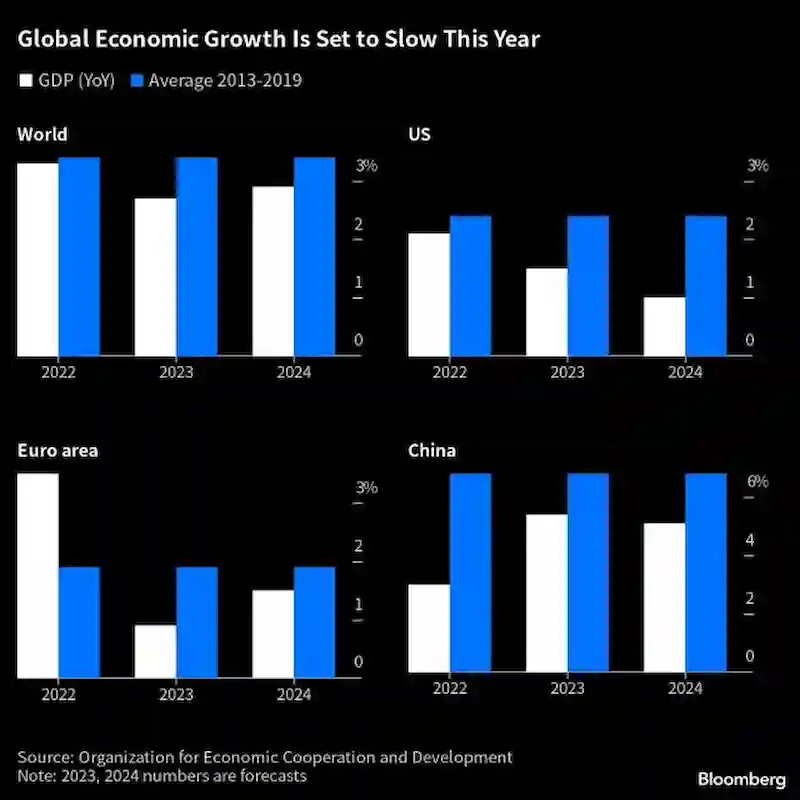


The Organization for Economic Cooperation and Development (OECD) has released its latest Economic Outlook report, which predicts a sluggish recovery for the global economy. The recovery is expected to be weaker due to the ongoing impact of the Covid-19 pandemic and Russia's war in Ukraine. The OECD forecasts that world output will expand by only 2.7% this year, with a modest pickup to 2.9% in 2024, both falling short of the pre-pandemic average of 3.4% over the previous seven years. The US, euro area, and China are all expected to see similarly sluggish recoveries.
One of the biggest challenges facing major central banks is persistent inflation, which has been higher than expected. This creates a delicate balancing act for central banks to continue to react to core price pressures without hurting growth. Clare Lombardelli, the chief economist of the OECD, said that central banks need to maintain restrictive monetary policy until there is evidence that inflation has durably returned to the target. This applies to both core inflation and headline inflation.
The caution comes as the World Bank recently warned that the global economy is in a precarious state and could experience a substantial growth slowdown later this year as interest-rate increases start to bite. Major monetary authorities face imminent decisions on whether to pause or pursue the fastest cycle of rate hikes since the 1980s. The OECD highlights that past rate hikes are beginning to have an impact, particularly in property and financial markets, but their full effect will not become apparent until later this year and in 2024. There is also still uncertainty about the strength of that impact and whether inflation could continue to be more persistent than expected.
The OECD has urged central banks to remain restrictive and even raise rates further if needed until there are clear signs that underlying inflationary pressure has decreased durably. The organization has also recommended that governments make fiscal support for households more targeted only to the most vulnerable to help central banks limit how much demand pressures stoke inflation. Despite the choices for fiscal policymakers being clearer, implementing them is politically sensitive due to their direct redistributive effects. Lombardelli said that the choices for governments are no easier to implement because of their inherent political sensitivity.