


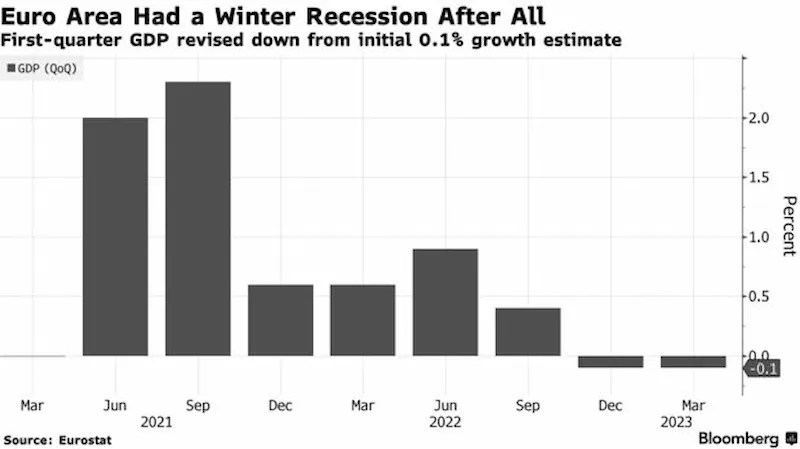


The euro area recently went through a mild recession during winter, triggered by Russia's war in Ukraine which resulted in energy prices soaring. The 20-nation economy shrank by 0.1% between January and March, as per revised data, after a similar decline from the previous quarter. This resulted in the first six-month contraction since the Covid-19 pandemic. Prior to this, analysts had predicted an output stall in the beginning of the year, and politicians and officials from the European Central Bank (ECB) had repeatedly stated that economic downturns could be averted, but inflation had skyrocketed to its highest level ever since the euro was introduced.
However, policymakers will be relieved that the billions of euros disbursed in aid to households across the bloc meant that economic damage, which could have been much worse, did not materialize in the aftermath of Russia's invasion. With growth likely to have returned this quarter, governments are moving ahead in rolling back fiscal support. The ECB is also unlikely to change course as it approaches the end of its historic campaign of interest-rate hikes and prioritizes defeating inflation as a prerequisite for sustainable economic expansion.
According to Eurostat, the euro area's first-quarter weakness was attributed to a decrease in government and household spending, with inventories making negative contributions while trade supported output. Recent data from Germany also revealed that Europe's biggest economy suffered a winter recession, as did Greece and Ireland. Estonia, on the other hand, has not seen growth ever since the end of 2021. Lithuania, Malta, and the Netherlands, too, contracted in the first quarter.
The outlook has since improved with the European Commission upgrading its predictions for the region and now forecasting that the Gross Domestic Product (GDP) will advance by 1.1% this year and 1.6% in 2024. There seems to be positive news on inflation too, with headline and underlying measures receding more than anticipated last month, although price gains still remain three times higher than the 2% target. Moreover, as consumers' expectations are moderating, this development offers some relief.
In spite of this, the ECB is expected to raise its deposit rate by a quarter-point to 3.5% next week.