


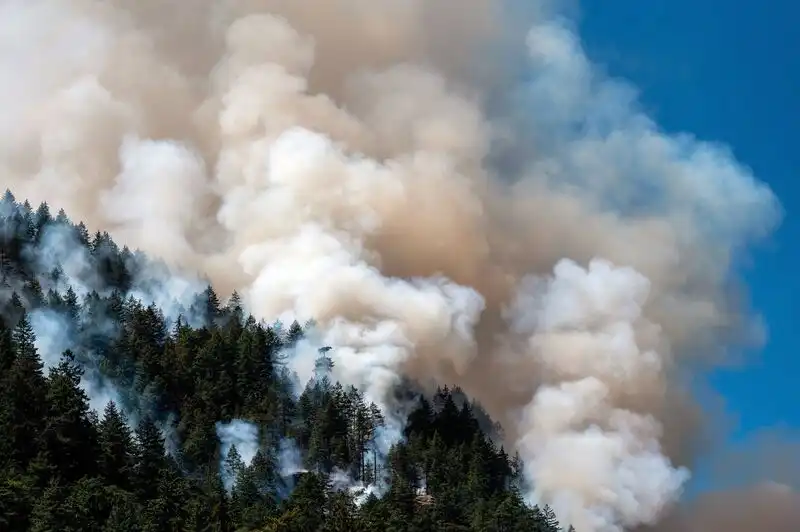


This year's wildfire season in Canada has already caused heavy carbon emissions due to burning vegetation including a carbon offset project. Mosaic Forest Management Corporation runs the BigCoast Forest Climate Initiative project, which experienced a blaze in early June that impacted about 0.25% of the project area. While it remains uncertain how much carbon has been emitted, the fire's emissions could be up to 32,250 tons of carbon dioxide equivalent depending on its severity, warned Werner Kurz, senior research scientist at the Canadian Forest Service. This incident highlights the challenges of relying on carbon offset projects to fight climate change, especially in the face of the potential increase in severity and frequency of wildfires caused by climate change.
Carbon offsets are tools used by companies and countries to reduce their climate pollution. However, some climate scientists claim that these tools, including forest offsets, are not an effective means of reducing climate change despite numerous experiments. Grayson Badgley, a researcher at US-based nonprofit CarbonPlan, said that expecting temporary carbon storage in trees to offset the carbon dioxide produced by fossil fuels burning is a "risky bet." The BigCoast project was founded on a 2018 commitment by Mosaic, a logging company, and its partners to stop tree felling activities and instead secure them for 30 years, hence the project's sustainability depends on carbon credit sale, that represents one ton of CO2 removed or not added to the atmosphere.
The BigCoast project has already distributed 1.4 million credits, equivalent to the total emissions of Sierra Leone in 2021, and purchased by firms including Aspen global insurance, UK-based AI firm Dataiku, and American Institute for Foreign Study, a travel and insurance firm. The project was developed based on the assumption that natural risks like wildfires have a zero possibility of breakdown, critics of carbon offsets say such assessments are naive, as fires are a substantial risk factor for forest offset projects, as are pest outbreaks and drought stress. Commenting on the issue, William Anderegg, director of the Wilkes Center for Climate Science and Policy, posits that assessing the wildfire threat as insignificant is mind-boggling. He warns that relying on credits allocated against other risks to manage fire incidents could seriously dilute their efficacy over the long run.
Verra’s buffer pool policies, which form an insurance policy against these threats do not account for the possibility of climate change-induced fires. A team of researchers from the Goldman School of Public Policy at the University of California, Berkeley, led by Barbara Haya, criticized the policy. In the US, CarbonPlan’s Badgley and his team of researchers found California’s buffer pool to be “severely undercapitalized.” Verra will update its insurance tool this summer to include the latest changes in risk due to climate change.
Offset developers are nervous about the ongoing wildfire situation in Canada, as the Monet Forest Conservation Project, Darkwoods and other forest conservation efforts face the wildfire risk. According to André Gravel, the chief executive of Société de gestion d'actifs forestiers(Solifor), the recent wildfires are a warning sign, given that frequency of wildfires is increasing. Adrian Leslie, the manager of a Nature Conservancy of Canada forestry offsets project called Darkwoods, says about 10% of the project's total area, or 4,485 hectares, burned in 2021, releasing 36,700 tonnes of CO2. Kurz also emphasized the need for developers to recognize and address this issue: “We have to bend the curve”.