




Turkey is implementing a series of unprecedented measures to address the excessive circulation of the lira, as the government aims to adopt more market-friendly policies. These moves come shortly after the central bank announced a smaller-than-expected interest rate hike but promised alternative measures to combat the country's soaring inflation, which is currently hovering around 40%.
One of the measures includes requiring banks to increase the amount of liras they park at the central bank to cover deposits under a program known as KKM. The reserve requirement ratio will now stand at 15% for deposits of six months or longer, up from zero. However, it will remain at 8% for deposits up to three months. This stricter rule is expected to draw approximately 450 billion liras from the banking system.
The KKM program, established in 2021 during a currency crisis, has witnessed significant deposits, reaching nearly 3 trillion liras ($111.4 billion) as of July 14, according to official data. It guarantees a state-backed return on lira deposits, aiming to match the decline of the currency against the dollar. However, many investors have criticized the introduction of KKM, arguing that it contributes to the growing labyrinth of market controls under President Recep Tayyip Erdogan.
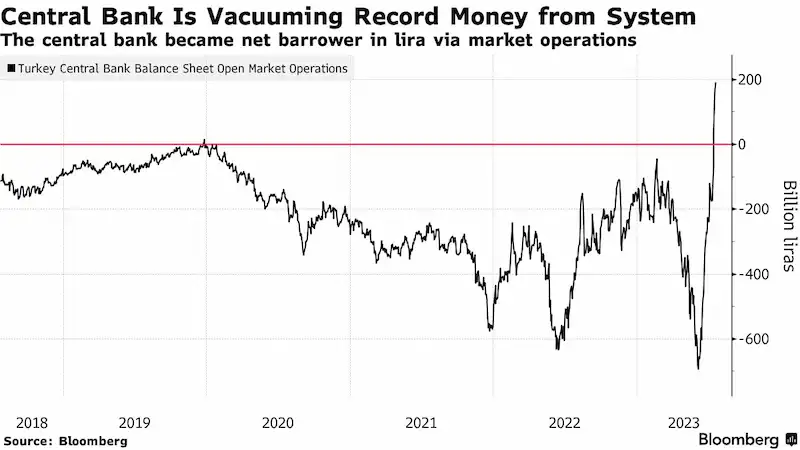
In addition to the KKM measure, the central bank has been withdrawing record amounts of money from the banking system this month to reduce lira liquidity. It has been a net borrower of liras via open market transactions for four consecutive days, according to Bloomberg data.
Even though the central bank raised its benchmark interest rate by 250 basis points to 17.5%, some economists deem this increase insufficient to provide adequate support for the lira and combat inflation. To address excess lira liquidity in the market, the central bank announced it would also implement "quantitative tightening and selective credit tightening."
These measures come as President Erdogan, who was reelected in May, aims to shift towards more orthodox economic policies and attract foreign investment to revive the country's dwindling reserves and tackle the cost-of-living crisis. In line with this shift, former Merrill Lynch bond strategist Mehmet Simsek was appointed as the finance minister in June. Simsek has previously expressed strong criticism of the KKM program, labeling it as a flawed initiative that has created significant challenges.
However, shutting down the KKM program could potentially add further pressure on the lira and the central bank's reserves if a significant number of savers opt to convert their lira deposits into dollars. The lira has already performed poorly against other emerging market currencies this year, depreciating by 31% against the dollar. As of now, it was trading 0.6% weaker at 26.9386 against the dollar.