


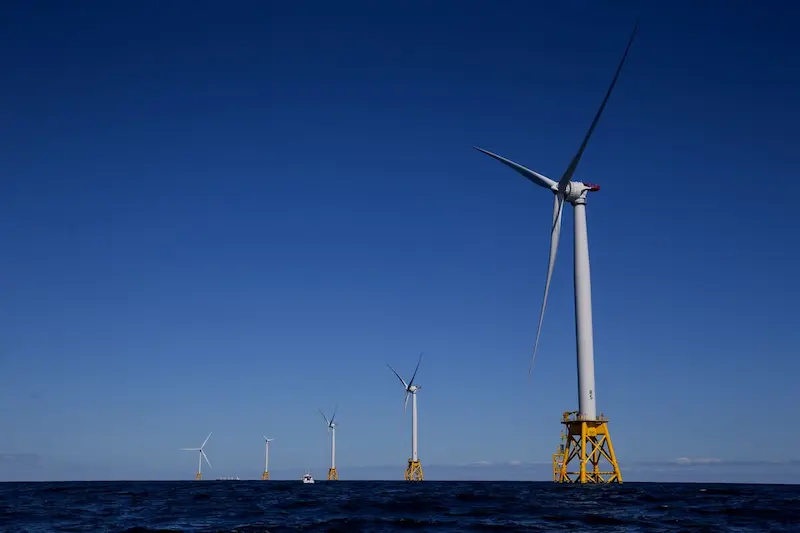


The Gulf of Mexico, known for its history as a major hub for US oil production, is now poised to become a center for offshore wind development. In a groundbreaking move, the government held an auction on Tuesday for wind development rights in tracts off the coasts of Texas and Louisiana. Over a dozen companies have qualified to bid, showcasing the growing interest in harnessing the region's potential for renewable energy.
The auction presents an opportunity to generate approximately 3.7 gigawatts of emission-free electricity, which can be used to produce green hydrogen and provide power to Gulf Coast refineries, ports, and shipyards. This has the potential to drastically reduce carbon emissions in what has previously been a carbon-intensive industrial base, according to Erik Milito, head of the National Ocean Industries Association.
Three tracts of land, each spanning about 100,000 acres, were up for grabs in the anonymous auction. Notable participants include companies such as BP, Equinor, Repsol, Shell, and TotalEnergies, which have a strong presence in the offshore oil industry. Additionally, renewable power companies like Hanwha, Hecate Energy, and Invenergy have also registered as potential bidders.
While previous wind lease auctions on the US East Coast have seen significant interest, the Gulf of Mexico presents unique challenges. Compared to the stronger winds on the East Coast, the wind speeds in the Gulf range from 7 to 9 meters per second. Developers will also have to design their projects to withstand seasonal hurricanes, a prevalent weather phenomenon in the region. Furthermore, unlike the East Coast states that have committed to procuring offshore wind power, no Gulf Coast state has established firm purchasing commitments.
However, the Gulf of Mexico possesses a significant advantage in terms of infrastructure and supply chains. The region is home to an extensive network of construction companies, shipyards, ports, and engineering firms that have long supported offshore oil and gas development. This existing industrial supply chain can be tapped into by wind developers to expedite project implementation.
Moreover, the Gulf Coast's expertise in offshore energy provides an opportunity for innovation and job creation. Through collaboration with local engineers and fabrication companies, the region can pioneer new methods for building and installing offshore wind turbines. This has the potential to drive economic growth and create stable business lines less susceptible to the volatility of the oil and gas industry.
President Joe Biden's target of deploying 30 gigawatts of offshore wind by the end of the decade relies heavily on the development of the Gulf of Mexico's wind potential. Catching up with European competitors, the US has seen most offshore wind leasing concentrated in the Northeast. By diversifying the geographic scope, the Gulf Coast can play a crucial role in meeting national climate goals.
The excitement among industry insiders is palpable, particularly in areas like Freeport, Texas, where welders and workers are eager to contribute to the offshore wind sector. The Gulf of Mexico's readiness to embrace the transition from oil-focused to renewable energy signals a promising future for the region and the wider push towards a greener, more sustainable energy landscape.