


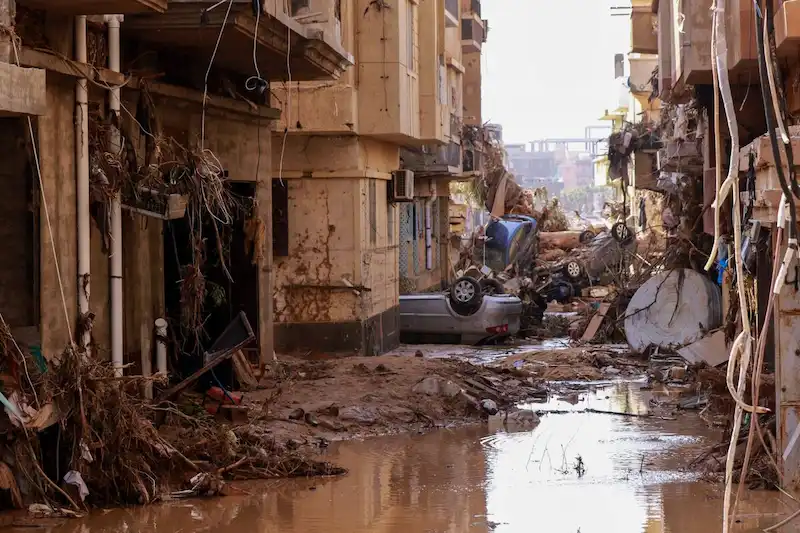


A frantic search is underway in eastern Libya after a powerful storm wreaked havoc, resulting in the deaths of at least 2,300 people, with almost all of them in a single city. The International Red Cross has reported that an additional 10,000 individuals are still missing. The eastern-based government's health minister, Othman Abdel-Jaleel, stated that out of the 6,700 people from Derna who have been accounted for, 700 have been identified and buried, while the rest remain unaccounted for. Meanwhile, the Tripoli-based government declared that the overall death toll in Derna stood at 1,900.
The massive storm hit shortly after Morocco experienced its most powerful earthquake in a century, leading to the deaths of at least 2,900 people in the kingdom. The situation in Libya has been described as a true disaster, with the extent of the damage and loss of life yet to be fully determined. The conflicting figures provided by different officials highlight the challenges in assessing the situation accurately and finding survivors. Water levels reached as high as the fourth and fifth floors of some buildings in Derna, according to Abdel-Jaleel.
The catastrophic flooding in Derna and other areas of Libya was triggered by two dams bursting after heavy rainfall. Entire regions in Derna were submerged, causing severe damage in neighboring cities like Benghazi, Sousse, and Al-Bayda. With the number of missing people, it is feared that the death toll will continue to rise. Egyptian President Abdel-Fattah El-Sisi announced his country's readiness to provide assistance and military support for search and rescue operations, given its proximity to Libya.
The political instability in Libya further complicates rescue efforts. The country, which possesses significant crude oil reserves, has been embroiled in conflict for years and is divided between rival governments in the east and west. Various attempts to reach a political agreement have failed, leaving the country in a state of chaos. Both governments have declared three days of mourning in response to the devastating storm.
In the east, where the Libyan National Army under Khalifa Haftar operates, most of the country's oil wealth and ports are located. This region also experienced a notable presence of religious extremists, including those affiliated with the Islamic State, following the downfall of former dictator Moammar Al Qaddafi in 2011. Haftar's forces managed to combat the extremists to some extent, but the lack of funds and ongoing unrest led to neglected infrastructure and scarce resources.
While progress has been made in certain aspects of unifying institutions in Libya, such as the central bank, challenges related to distribution of wealth and provision of services remain. Disputes over oil wealth allocation have resulted in a lack of funding, further exacerbating the country's infrastructure issues. The intermittent fighting has also disrupted oil ports and exports.
However, amidst all the devastation, there is a glimmer of hope as the country's main energy ports of Es Sider, Ras Lanuf, Zueitina, Brega, and Hariga, which were temporarily closed due to the storm, have been reopened without significant damage. Efforts are ongoing to salvage the situation, with rescue operations underway to help those stranded and find the missing individuals in a race against time.