


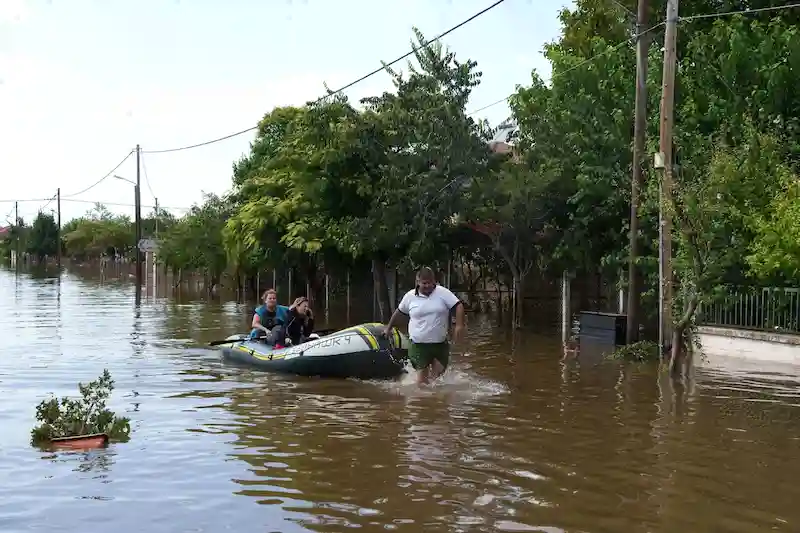


A recent study conducted by World Weather Attribution (WWA) has found that the heavy rainfall and subsequent flooding that devastated Greece, Bulgaria, Turkey, and Libya last week was significantly amplified by climate change. According to the report, global warming caused by human-induced greenhouse gas emissions made the extreme rainfall events up to 10 times more likely in the eastern Mediterranean, while in Libya specifically, the deluge was up to 50 times more likely.
The Mediterranean basin is warming at a rate 20% faster than the rest of the planet, as per the United Nations. This, coupled with the effects of climate change, has led to the increased unpredictability of weather patterns and the occurrence of violent storms that result in substantial amounts of rainfall in short periods of time. Unfortunately, the lack of preparedness coupled with the changing climate contributed to the tragic loss of nearly 4,000 lives in Libya.
A storm known as Daniel caused the worst flooding in Greece since records began in 1930. This storm was also the deadliest since 2008, when Cyclone Nargis claimed over 130,000 lives in Myanmar. Between September 4 and 7, Storm Daniel unleashed a staggering 760 millimeters of rainfall per square meter in certain areas, causing severe flooding in the Thessaly plain which accounts for a significant portion of Greece's agricultural production. The analysis carried out by WWA reveals that carbon emissions are responsible for up to 40% more rainfall than would have occurred under normal climatic conditions.
The scientists involved in the study have noted that these extreme rainfall events are becoming more common and are expected to occur once every decade. In the region encompassing Greece, Bulgaria, and Turkey, there is a 10% chance of such an event happening each year. For central Greece, such extreme precipitation is projected to happen only once every 80 to 100 years.
The devastating impact of Storm Daniel has prompted Greece to reevaluate its policies for early warning systems and the structure of its civil protection agencies. It has become glaringly evident that first responders and scientists need to work together to be better prepared for such catastrophic events in the future.
After sweeping through Greece, the storm continued southward over the Mediterranean Sea, gaining strength before hitting Libya. Experts are currently investigating whether Storm Daniel can be classified as a "medicane" (Mediterranean hurricane). Although it exhibited some similar characteristics, its sluggish movement led scientists to doubt its classification as a true medicane.
The study by WWA also shed light on the heavy rainfall that struck Libya on September 11. The findings suggest that such intense rainfall events occur only once every 300 to 600 years under the current climate conditions. However, global warming has increased the intensity of these events by as much as 50%. Tragically, over 10,000 people remain missing in the city of Derna as rescue teams race against time to find survivors.
It is important to note that the high death toll cannot be attributed solely to the rainfall. The collapse of two dams and several bridges, which resulted in widespread flooding, compounded the disaster. In Libya's case, a decade-long armed conflict, political instability, and weak institutions contributed to the poor maintenance of critical infrastructure and a lack of planning and protocols to address extreme weather events.
This catastrophe underscores the challenge of maintaining and adapting outdated infrastructure to cope with present-day weather conditions. In the case of Libya, this means accounting for a long-term decline in rainfall while simultaneously preparing for instances of more extreme rainfall.
Efforts to adapt to these changing conditions should not be hindered by the apparent contradiction between drought and flood planning. Many actions required to address both drought and flooding are similar, such as reforestation, river naturalization, and modifying ground sealing. Additionally, access to early warning systems, information, and healthcare services are crucial in responding to and mitigating the impacts of all forms of extreme weather events.