


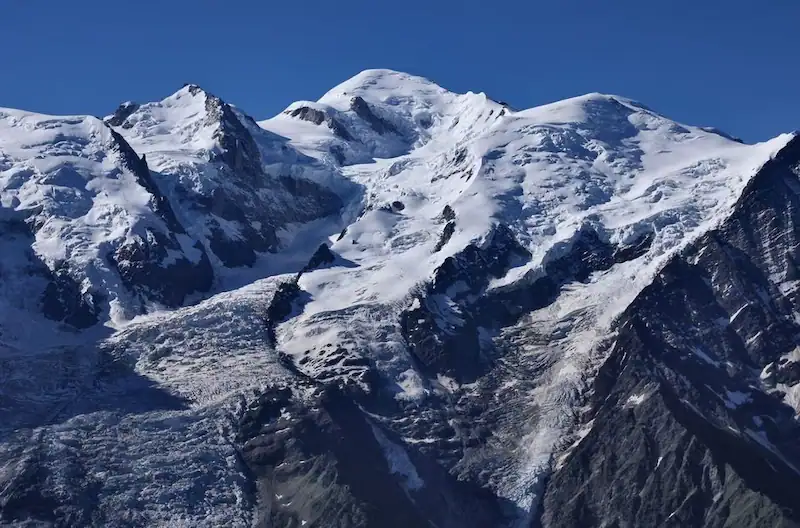


Mont Blanc, the highest peak in Western Europe, has undergone a startling transformation, shrinking by over two meters in just two years, according to a recent report by a team of topographers. The mountain now stands at its lowest recorded height since precise measurements began 22 years ago, measuring 4,805.59 meters (15,766 ft). This significant loss in elevation is attributed to warmer summers, which have resulted in the reduction of snowpack size.
The UNGE surveyors union, responsible for conducting measurements on Mont Blanc every two years, announced the alarming decrease in height at a news conference held in Chamonix, located in the French Alps. Cecile Taffin, a member of the union, described Mont Blanc's peak as being akin to a shifting dune and emphasized that similar height variations exceeding two meters have been observed in the past. However, this year's decline is particularly notable and is likely attributed to a lack of rainfall coupled with a scorching summer.
Detailed satellite measurements utilizing GNSS technology began in September 2001 when Mont Blanc was recorded at an elevation of 4,010.40 meters. From 2001 to 2013, the mountain's height fluctuated between 4,808 and 4,810 meters, with a peak of 4,810.90 meters (15,783.79 ft) recorded in 2007. However, since 2013, Mont Blanc has been consistently losing elevation, and the current downward trend is cause for concern.
The height of Mont Blanc is determined by its snowpack, which typically increases during the summer months as rain on the peak transitions into snow. Farouk Kadded, of Leica Geosystems, noted that this year marked the first time since 2015 that Mont Blanc's snowpack remained virtually unchanged from June to September. Typically, the mountain gains around one meter in elevation during this time, but record-breaking temperatures, including a high of 10 degrees Celsius, prevented this usual trend.
The topographers responsible for the measurements stressed that it was not within their expertise to interpret the data. They acknowledged that climate change specialists would analyze the findings and propose theories to explain this remarkable phenomenon. Prior to GNSS technology, scientists relied on less precise methods such as GPS, trigonometric estimates, and barometric measurements, which often produced inconsistencies of several meters.
Despite the fluctuations, the experts expressed doubts about the possibility of recovering the lost elevation in the upcoming two years. While there are variations in the measurements, a general downward trend is evident. The long-term implications of Mont Blanc's shrinking height remain uncertain, but the findings raise concern about the effects of climate change on one of Europe's most iconic natural landmarks.