


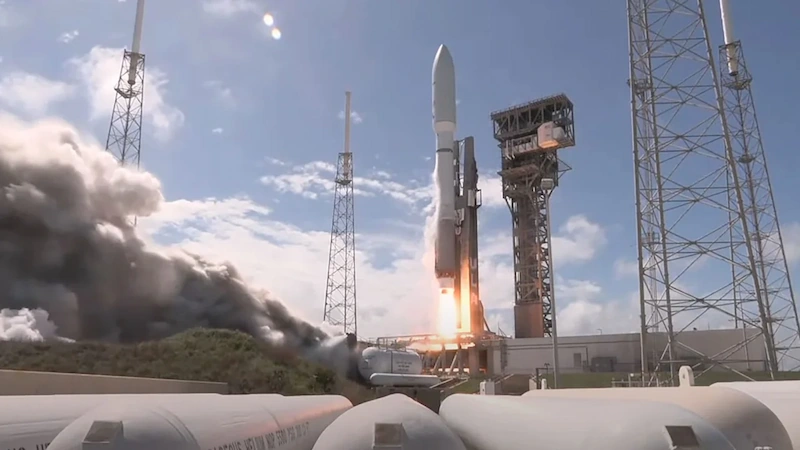


Amazon has officially stepped into the competition for creating large assemblies of satellites aimed at global internet connectivity, directly challenging SpaceX and its world-renowned Starlink system. Project Kuiper, Amazon's network initiative, recently launched its first two prototype satellites from Cape Canaveral, Florida via a United Launch Alliance rocket. The launch marked Amazon's first foray into deploying satellites into space. Rajeev Badyal, Project Kuiper’s vice president of technology, highlighted in a statement the invaluable learnings expected from the on-orbit testing, regardless of the mission's outcome.
If the mission proves productive, Amazon aims to repeatedly launch hundreds of satellites to form a constellation of over 3,200 satellites. The end objective is to have this network working in sync to provide seamless internet connectivity worldwide, a business strategy similar to that of SpaceX’s Starlink. To date, SpaceX possesses more than 4,500 operational Starlink satellites in orbit, providing residential and commercial services across most parts of the Americas, Europe, and Australia.
This represents an evolution in the space industry which largely relied on expensive, bulky satellites stationed in the geosynchronous orbit at considerable distances from Earth. This often resulted in delayed connectivity due to the satellites' distance, prompting companies like SpaceX, OneWeb, and now Amazon, to bring satellites closer to Earth.
Past efforts to deliver consumer-driven, high-speed satellite internet witnessed several bankruptcies due to the high operational expenditure. However, affordable satellites and decreased launch costs have stimulated the rise of "megaconstellations" in low-Earth orbit (LEO), placed less than 600 miles (1,000 kilometers) above Earth. Despite requiring thousands of satellites for comprehensive planetary coverage, this approach could revolutionize worldwide access to high-speed internet.
While SpaceX remains arguably ahead in this race, it has had its fair share of global controversies. Particularly its initial decision to prevent Ukrainian soldiers from using Starlink services during the conflict with Russia, a move later reversed. Amazon's Project Kuiper may face comparable global challenges if it achieves success.
However, megaconstellations are not without their controversies, primarily due to the significant increase in space debris and the increased risk of catastrophic collisions in the low-Earth orbit. The American Federal Communications Commission, the authorizer of space-based telecommunication services, is already fortifying its space debris mitigation policies.
Expressing its commitment to sustainability, Amazon vows to ensure its satellites' maneuverability while in orbit and safely deorbit the first two test satellites post-mission. Still, many astronomers express their concern about these satellites' impact on the night sky and the disruptions they might cause to telescope observations and research.
The competition between Amazon's Project Kuiper and SpaceX's Starlink is yet to unravel. Although Starlink boasts more than a million customers, it has not been as successful as projections suggested. Amazon aims to make the Project Kuiper terminal accessible at approximately $400 per device, but specifics about demonstration or sales and pricing for the service are yet to be revealed.
Currently, while SpaceX has the advantage of using Falcon 9 rockets for launching Starlink satellites, Amazon lacks its own rockets. Even though Blue Origin, a rocket company founded by Jeff Bezos, is developing an orbit-capable rocket, the launch schedule and pricing structure have not been finalized. As a result, United Launch Alliance's rockets, a close ally of Blue Origin, are being used for launching the Kuiper satellites.
As of now, the race for global space-based internet continues to intensify with Amazon's Project Kuiper stepping into the ring with ambitious plans and promised commitments.