


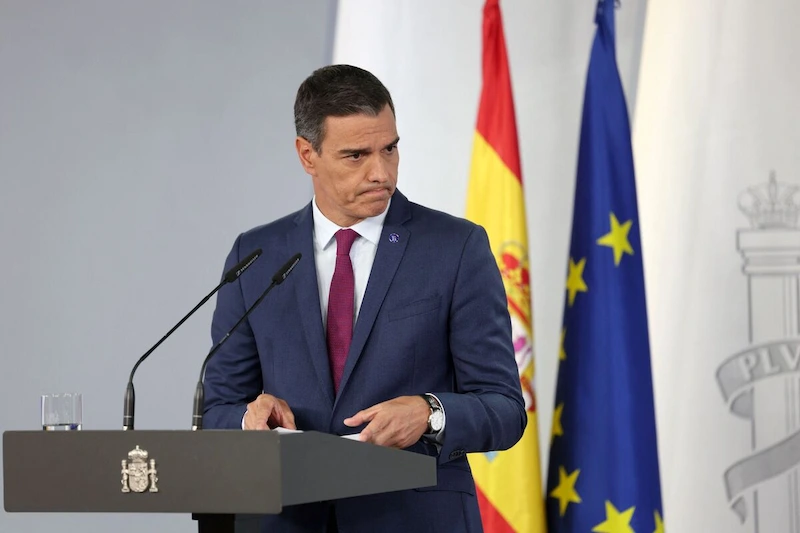


Prime Minister Pedro Sanchez of Spain is taking a bold gamble in an attempt to secure his third term and stabilize the country's political landscape. After losing the July election, Sanchez's Socialist party has agreed to grant amnesties to hundreds of Catalan separatists who were involved in the attempt to break up Spain six years ago. In exchange, Sanchez will gain the necessary parliamentary support to take office for a third term. However, this move has sparked outrage among Spanish conservatives.
If Sanchez's plan succeeds, he will solidify his position as the country's longest-serving premier since 1996. He aims to normalize Catalonia's position within Spain and establish a progressive majority in the fourth largest economy of the European Union. Nonetheless, there are considerable risks associated with his strategy. It could potentially revive the separatist movement, plunge Spain into constitutional crisis, and exacerbate ideological divisions that have paralyzed the country since the illegal Catalan independence referendum in 2017.
Spanish conservatives have responded with visceral opposition to the amnesty decision. Many view the former Catalan President, Carles Puigdemont, who is set to return from exile in Brussels, as a traitor and criminal. Critics argue that the amnesty provides a blank check to separatists without adequately defending the interests of Spain. Thousands of protesters, primarily from the far-right, have gathered outside the Socialists' party headquarters, resulting in clashes with the police.
In addition to conservative backlash, various judges' associations and business lobby groups have expressed concern about the amnesty deal. They criticize references to legal proceedings and fear it may undermine democracy. The European Justice Commissioner, Didier Reynders, had also raised questions about the planned amnesty law. However, the government mentioned that, in its caretaker capacity, bills must be filed by lawmakers.
The opposition People's Party, Spain's largest political group, is organizing demonstrations in Madrid and other cities on Sunday to express their disagreement with the amnesty decision. The 2017 referendum, which saw violent clashes between riot police and voters in Barcelona, continues to be a highly charged issue that stirs strong emotions across Spain.
Critics are quick to point out the apparent hypocrisy of Prime Minister Sanchez, who rejected the possibility of amnesty just two days before the election. His change in stance is seen as a calculated move to gain support from separatists. However, videos showcasing upper-class Madrileños hurling homophobic and racist abuse at the police highlight the increasing rancor in Spain and reflect wider fault lines within European communities amidst conflicts like that between Israel and Hamas.
Sanchez's actions and ideological clashes have profound implications for Spain's foreign policy. Spain is one of the few EU countries that has not recognized the independence of Kosovo, due to concerns about setting a precedent that could validate Catalonia's demands for self-determination. The government's endorsement of a two-state solution in the Israel-Hamas conflict aligns with the shift that Sanchez is trying to navigate in the Catalan crisis.
The negotiations between the government and Catalan separatist leaders, such as Puigdemont, have been shrouded in secrecy. Besides the amnesty, Sanchez has also agreed to revise the funding mechanism for Catalonia and develop a plan to encourage companies that left during the 2017 turmoil to return. The separatists have toned down their demand for an independent referendum, stating that they will propose one within the framework of the Constitution.
Sanchez and his allies view these discussions as part of a broader strategy to defuse the separatist conflict in Catalonia and reintegrate the region into national politics. However, the tense atmosphere surrounding these debates was further heightened when the co-founder of the far-right Vox party, Alejo Vidal-Quadras, was shot in the face in Madrid. While the motives behind the attack remain unclear, opponents of Sanchez have attempted to connect it to the amnesty deal.
Despite the challenges and opposition he faces, Sanchez has a remarkable track record of navigating political obstacles. After pardoning nine separatist leaders in 2021, his party maintained support in the July election and achieved its best result in Catalonia in a decade. Additionally, Spain's economic performance amidst the pandemic, with robust GDP growth and controlled inflation, works in his favor.
Sanchez's gamble hinges on the belief that amnesty will diminish the separatists' claims to victimhood and force them to focus on more everyday concerns, such as jobs and public services. With regional elections in Catalonia looming, the Socialists have a chance to win back their electoral stronghold.
Nonetheless, the road ahead for Sanchez is paved with challenges, particularly the anger and opposition brewing in Madrid. The coming months will test his political acumen and determine whether his gamble pays off or further deepens the divisions within Spain.