


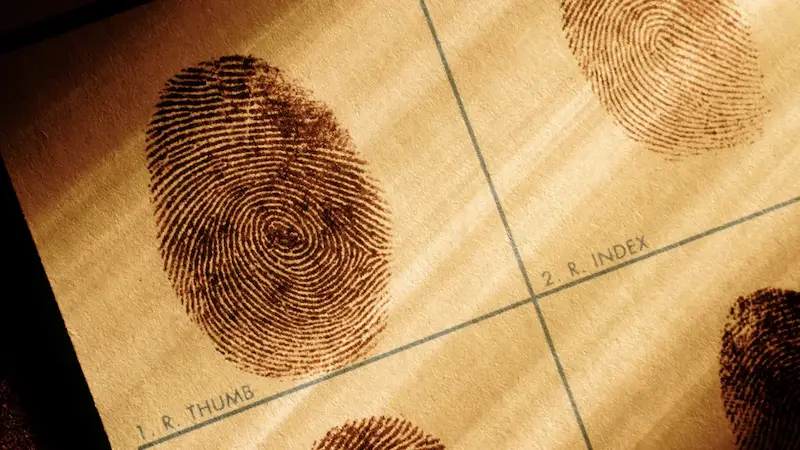


A groundbreaking study conducted by a team led by Gabe Guo, an undergraduate senior in Columbia University's department of computer science, has raised doubts about the long-held belief that every fingerprint is unique. Published in the journal Science Advances, the study challenges conventional wisdom and has garnered attention for its potential implications in forensic science.
Guo and his colleagues, including professor Wenyao Xu of the University of Buffalo, used an artificial intelligence model called a deep contrastive network to analyze a US government database of 60,000 fingerprints. The AI-based system identified strong similarities between fingerprints from different fingers of the same person. Surprisingly, the accuracy of the system peaked at 77% for correctly identifying whether two prints belonged to the same individual, thus suggesting that fingerprints are not entirely unique.
Previous approaches to fingerprint analysis focused on certain features known as "minutiae," which are specific markers used for identification. However, the team found that these minutiae were effective for matching fingerprints but not reliable for identifying correlations between prints from the same person. Instead, the study identified the angles and curvatures at the center of the fingerprint as key factors for determining similarity.
While the study faced considerable pushback initially, it persisted, continuously refining its methodology and incorporating more data until the evidence became irrefutable. The team acknowledges potential biases in the data and calls for further validation by analyzing a larger and more diverse database for the AI system's practical application in forensics.
Although some experts have argued that the study merely reiterates what has long been known about fingerprint similarities, Guo stands behind the groundbreaking nature of their research. While the correlation between fingerprint shapes was acknowledged in earlier manual fingerprinting methods, no previous study had quantified or exploited these similarities to the extent achieved by Guo's team.
Christophe Champod, a forensic science professor at the University of Lausanne, Switzerland, acknowledges the significance of the deep learning techniques employed but suggests that the study may have overstated its findings. Champod argues that the correlation between fingerprint shapes has been recognized for years. However, Guo counters that this study is the first to explicitly identify the role of ridge orientation and attempt automated matching of fingerprints from different fingers of the same individual.
Simon Cole, a professor in criminology, law, and society at the University of California, Irvine, supports the study's interesting contribution but cautions against overstating its practical application. Cole points out that law enforcement typically records all ten fingers and often palms, minimizing the likelihood of encountering mismatches between crime scene prints and existing records.
Despite differing opinions on the significance of the study's findings, the team remains confident in its results and has made the AI code open-source for further examination. Guo emphasizes that this research transcends the realm of forensics, highlighting the power of AI to uncover hidden patterns that have eluded human observation for centuries.
As AI continues to evolve, Guo believes that we are on the brink of a new era where AI will unveil insights that were previously unnoticed. The study's impact extends beyond the realm of fingerprints and underscores the transformative potential of AI in various fields of knowledge.