


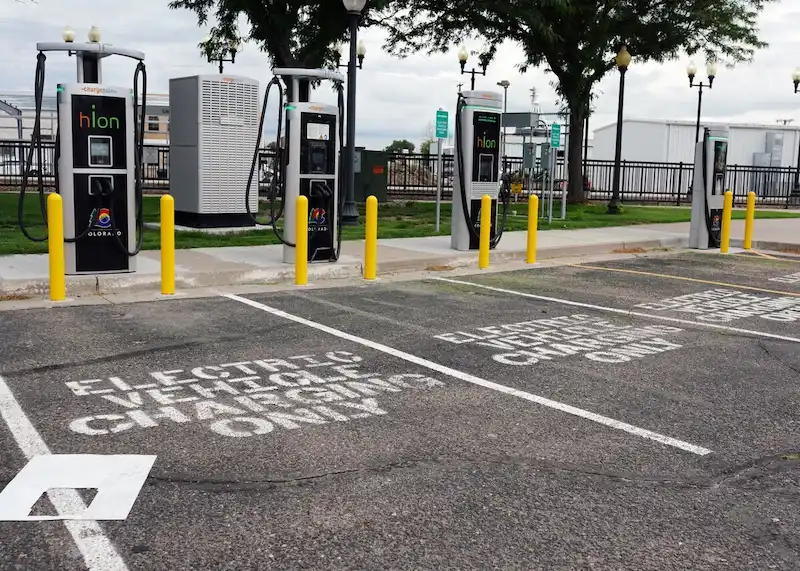


The electrification of rural America has long posed challenges for the widespread use of electric vehicles (EVs). However, this problem is rapidly diminishing as more and more charging stations are being established across the country. According to a Bloomberg Green analysis of federal data, nearly 1,100 new public, fast-charging stations were added in the US during the second half of 2023, representing a 16% increase. This means that there is now approximately one fast-charging station for every 16 gas stations in the country.
Katherine Garcia, the director of Clean Transportation for All at the Sierra Club, expressed enthusiasm about this progress, stating that it is an exciting moment and expects to see further growth in this trajectory. Importantly, this surge in charging infrastructure isn't just limited to areas known for their high adoption rates of EVs. States like Idaho, as well as regions in the Deep South such as Alabama, Arkansas, Mississippi, and Tennessee, saw a notable increase in the number of fast-charging stations. Florida and Texas are now ranked second and third, respectively, in terms of the states with the most charging spots.
Albert Gore, the executive director of the Zero Emission Transportation Association, pointed out that opponents of EVs have often used the argument that the infrastructure is not yet ready. However, this growth in charging stations proves otherwise. Gore noted that many drivers may not be aware of the charging stations nearby because they are not as noticeable as gas stations. Those who charge their EVs at home may not find the need to seek out public charging stations regularly.
The expansion of charging infrastructure shows no signs of slowing down. Last year, a significant portion of the chargers added in the US were investments made by for-profit companies recognizing the future of battery-powered driving. This year, $5 billion of federal funds will be allocated by states to ensure the charger network is dense enough to make EV adoption an easy choice. The National Electric Vehicle Infrastructure program aims to have a public fast-charging station every 50 miles along major travel routes. Some states, including Alaska, Hawaii, and Kentucky, have already begun distributing these funds, and the first federally supported charging stations were activated in December near Columbus, Ohio.
Additionally, Tesla Inc. will be opening its network of Superchargers to vehicles manufactured by other automakers. Currently, Tesla is responsible for over a quarter of all fast-charging stations in the US, and although its sites tend to be larger, approximately two-thirds of the country's charging cords are tailored for Tesla ports.
Samantha Houston, a senior vehicles analyst at the Union of Concerned Scientists, believes that the influx of new charging stations will boost the demand for EVs. As the electric fleet becomes denser and charging station pricing becomes more flexible based on electricity demand, the economics of operating a charging station are improving. Houston sees this as a positive cycle that will help accelerate the transition to EVs, benefiting both the climate and local air quality.
In summary, the US has witnessed significant progress in expanding its charging infrastructure network, with the addition of over 1,000 new fast-charging stations in the latter half of 2023. This surge in charging stations not only encompasses areas with high EV adoption but also stretches into previously underserved regions. With billions of dollars in federal funding being deployed to further enhance the charging network and Tesla opening its Supercharger network to other automakers, the future looks promising for EVs in America.