


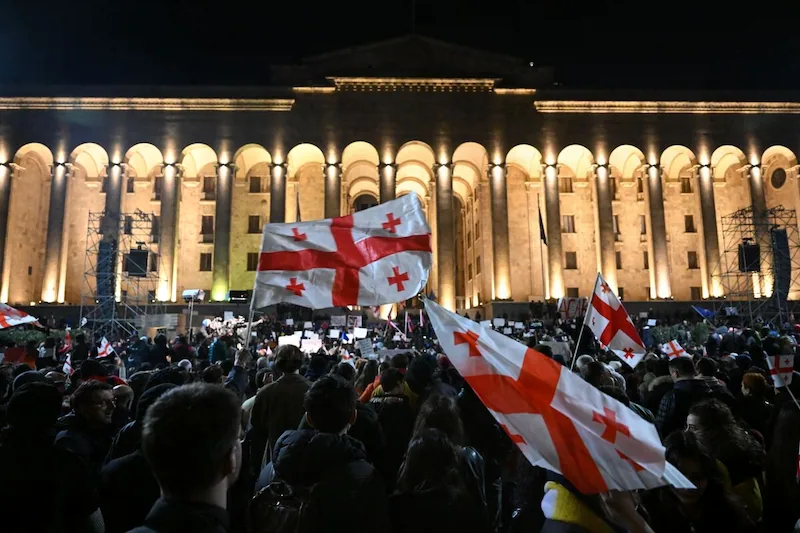


Georgian Dream, the ruling party in Georgia, has announced plans to reintroduce a draft law targeting "foreign agents" that sparked uproar and violent clashes during protests last year. The legislation, which received strong criticism from the US and the European Union, is designed to make non-governmental organizations disclose their sources of funding. Georgian Dream alleges that civil society groups are engaged in promoting extremism and disseminating what they describe as "pseudo-liberal ideology" and "LGBT propaganda," with the support of foreign foundations.
The controversial law had previously led to public dissent, including a stark divide between President Salome Zourabichvili and the Georgian Dream party, founded by billionaire Bidzina Ivanishvili. The US and EU had likened the proposed measure to tactics employed by Russian President Vladimir Putin to stifle dissent within Russia. Despite the fierce opposition, Georgian Dream is moving forward with the legislation, aiming to pass it in time for the upcoming parliamentary elections in October.
President Zourabichvili had previously stood with thousands of protesters in Tbilisi, denouncing the law as a threat to Georgia's aspirations to join the EU. The original version of the law had severe penalties, including fines and imprisonment, for organizations receiving significant funding from abroad and failing to register as "agents of foreign influence." The revised version, while maintaining the same content, will replace the term "foreign agent" with "organization pursuing the interests of a foreign power," according to Georgian Dream's parliamentary faction leader Mamuka Mdinaradze.
Opposition groups have swiftly denounced the revival of the law, framing it as an assault on Western values and democratic principles. Roman Gotsiridze, an opposition member of parliament, decried the move as a "war on the Western community," suggesting that the government is keen on using the law as a tool to control dissent ahead of the crucial parliamentary elections. As tensions escalate once again, Georgia finds itself at a crossroads between safeguarding democratic freedoms and succumbing to authoritarian measures in the name of national security.