


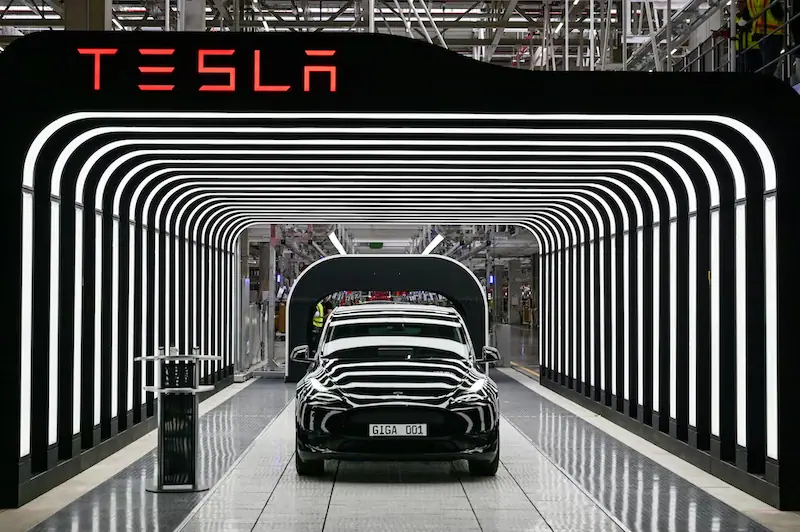


Tesla has initiated the production of right-hand drive vehicles at its facility in Germany, setting the stage for export to India later in 2024, say sources familiar with the company's strategies. As the electric car giant eyes entry into India, a team from Tesla is anticipated to visit the country this month to scout potential locations for establishing a domestic manufacturing plant that could necessitate an investment of approximately $2 billion. This move aligns with India's recent reduction in import tax rates for specific electric vehicles, provided the manufacturers commit to investing at least $500 million and commencing local production within three years, a development advantageous to Tesla following its persistent lobbying efforts for reduced taxes amidst resistance from local automotive manufacturers.
The decision to commence production of right-hand drive vehicles earmarked for the Indian market marks a significant milestone, with shipments of these cars expected to commence by the end of this year. While the specific model Tesla intends to export to India remains undisclosed, the company currently manufactures the Model Y at its plant near Berlin. Moreover, under the new Indian policy, companies are permitted to import up to 8,000 cars annually at the reduced tax rate, offering a favorable landscape for Tesla's market entry and expansion within India’s burgeoning electric vehicle sector.
Recognizing the potential of the Indian market, Tesla's expansion plans not only involve vehicle production but also include investments in a robust charging infrastructure, which will be in addition to the $2 billion allocated for the manufacturing plant. Furthermore, Tesla aims to enhance its local sourcing network, with plans to reduce dependency on Chinese suppliers in favor of elevating India as a primary sourcing hub. The company's keen interest is evident in its exploration of potential plant locations in states such as Tamil Nadu, Maharashtra, and Gujarat, where it aims to establish a factory within a two-year timeframe.
While Tata Motors currently dominates India's electric vehicle market, accounting for a substantial portion of total car sales, the government's ambitious target of achieving 30% electric vehicle sales by 2030 presents a vast growth opportunity. Tesla's foray into India, coupled with investments in manufacturing, charging infrastructure, and local component sourcing, signifies a strategic move to capture a share of India's evolving electric mobility landscape. As competition intensifies and EV demand in Tesla's key markets stabilizes, the company's entry into India represents a strategic pivot towards harnessing the potential of a rapidly evolving market ripe for sustainable mobility solutions.