


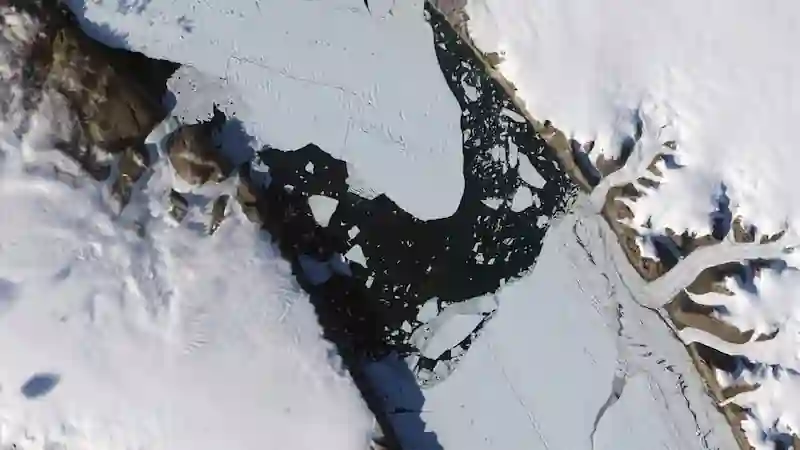


A new study by glaciologists from the University of California, Irvine and NASA’s Jet Propulsion Laboratory has revealed that a major glacier in northwest Greenland is interacting with the ocean tides, resulting in previously unaccounted-for melting and potentially faster sea level rise. The study, published in the Proceedings of the National Academy of Sciences, found that the grounding line of the Petermann Glacier, which is the area where the ice sheet begins to extend out on top of the ocean, can shift significantly as tides come in and out each day. The grounding line was found to migrate between 2 and 6 kilometers (1.2 to 3.7 miles) as tides come in and out, which is an important finding, as the traditional view among scientists was that the grounding line did not migrate with the tides, and this introduces another major source of melting that could be accelerating sea level rise.
The study also revealed that between 2016 and 2022, warmer tidal cycles melted a 670-foot-tall hole in the underside of the glacier along the grounding line, which is big enough that two Statues of Liberty could be stacked on top of one another inside it. The phenomenon could worsen in the coming years and decades as ocean temperatures climb. Recently reported that sea surface temperatures were at their highest on record this spring, which has alarmed scientists who are concerned it could be part of a worrying new trend.
The study raises more concerns for the already worrisome prospect of sea level rise, which threatens coastlines around the world. Greenland’s melting ice is the single largest contributor to sea level rise, according to NASA, which has been accelerating in recent years. But current projections do not account for this newfound contribution from under-ice interactions with warming tides. Co-author Eric Rignot, a professor at UCI and NASA JPL research scientist, said, “These ice-ocean interactions make the glaciers more sensitive to ocean warming. These dynamics are not included in models, and if we were to include them, it would increase projections of sea level rise by up to 200 percent – not just for Petermann but for all glaciers ending in the ocean, which is most of northern Greenland and all of Antarctica.” The study underscores the urgent need for action to mitigate climate change and reduce greenhouse gas emissions to prevent further damage to our planet.