


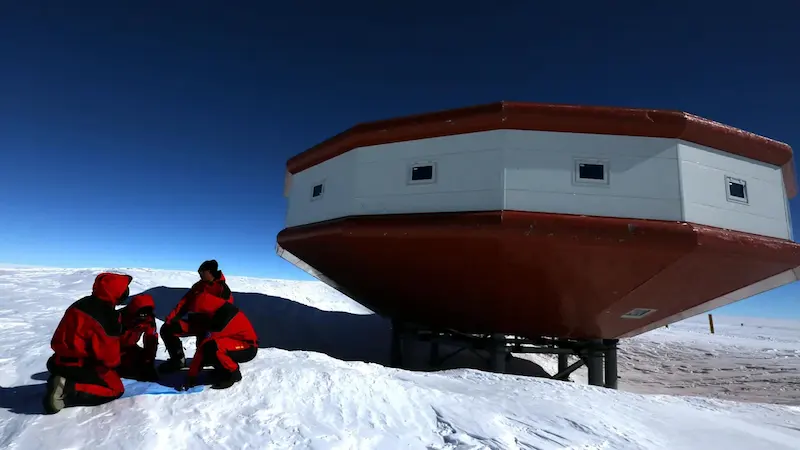


China has made significant progress in the construction of its fifth research facility in Antarctica, according to a recent report by the Center for Strategic and International Studies (CSIS). The new research station, which China views as a means to expand its scientific investigation in the Antarctic, is being built on Inexpressible Island near the Ross Sea. The site is being developed following several years of dormancy after construction began in 2018. The CSIS report, based on satellite imagery taken in recent months by Maxar, notes that new support facilities and groundwork for a larger structure have appeared at the site.
While China is not the only country to bolster its presence and research activities in Antarctica, the new station's position, triangulated with China's other coastal stations on Antarctica, could support intelligence collection given its inclusion of a satellite ground station. The CSIS report suggests that the station's location may enable China to collect signals intelligence from US-allied Australia and New Zealand, and to collect telemetry data on rockets launching from newly established space facilities in both countries.
Once completed, the 5,000-square-meter station is expected to include a scientific research and observation area, an energy facility, a main building, a logistics facility, and a wharf for China's Xuelong icebreakers. The scientific research conducted at the station will reportedly focus on physical and biological oceanography, glaciology, marine ecology, zoology, atmospheric and space physics, and geology.
While China has stressed the scientific nature of its ambitions in the region, the CSIS report notes that the new research facility could also be used to enhance the country's intelligence collection capabilities. This has raised concerns in the West about Beijing's assertive foreign policy and surveillance capabilities. Under the Antarctic Treaty, to which China is a party, activities on the continent are restricted to "peaceful purposes," and military personnel are allowed to conduct scientific research, but may not set up bases, test weapons or carry out maneuvers.