


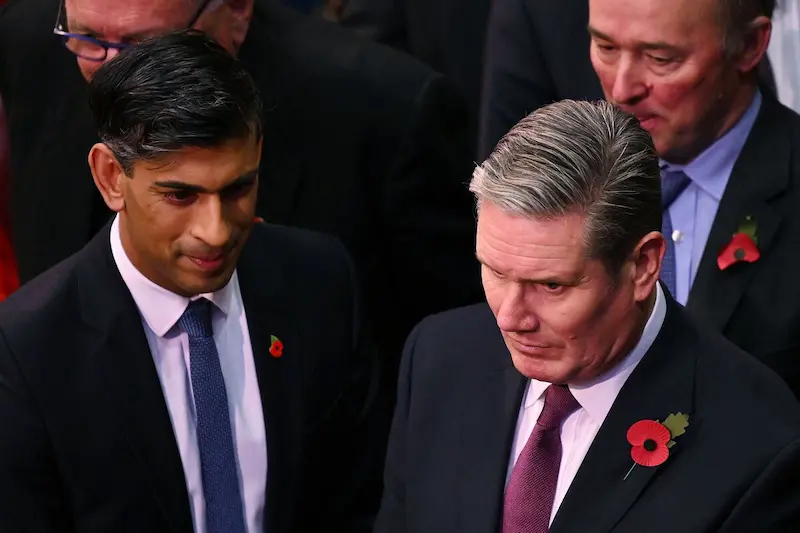


Prime Minister Rishi Sunak and opposition leader Keir Starmer engaged in a heated exchange as they faced off in the House of Commons, signaling the beginning of what is expected to be a year-long battle for control of the government. Insults were hurled from both sides, with Sunak accusing Starmer of pandering to his "union friends," while Starmer mockingly referred to the Prime Minister as "Mr. Nobody." This fiery clash foreshadows a bitter election campaign ahead.
Starmer took a jab at Sunak's shifting strategy, highlighting his decision to abandon his image as an agent of change and embrace continuity instead, a report published by Bloomberg on Monday revealed. Referring to Sunak's self-reinvention, Starmer taunted, "Last year he started the year saying he was Mr. Steady. Then at his conference he was Mr. Change. Now he's flipped back to Mr. More of the Same. It doesn't matter how many relaunches and flip-flops he does, he'll always be Mr. Nobody."
Sunak, in his reply, stuck to his usual attack line, claiming that the Labour Party lacks a detailed plan to tackle pressing issues, including the influx of asylum-seekers arriving in small boats across the English Channel. Sunak argued that Starmer peddles different messages to his union allies and the British public and accused him of lacking a cohesive plan. "It's always the same thing with him: There's no plan - it's peddling one thing to his union friends and another thing to the British people," Sunak asserted.
Nonetheless, Sunak reemphasized the central message of his revised strategy, taking a veiled swipe at Starmer in the process. "It's crystal clear: Stick with us to deliver the long-term change that the country needs. Don't go back to square one with him," Sunak proclaimed.
This heated exchange sets the stage for a pugilistic year in Parliament, with the Prime Minister resisting demands from the opposition for an election in May, especially since his party is currently trailing Labour by about 20 points in the polls.
Sunak indicated last week that his "working assumption" was to dissolve Parliament in the latter half of the year, effectively running down the clock until the January 2025 deadline for a nationwide vote. Labour is hoping to return to power after a 14-year absence.
Sunak faces an uphill battle in his first national campaign as leader, starting with the controversial plan to deport asylum-seekers to Rwanda. This plan has faced legal challenges, including a UK Supreme Court ruling declaring it unlawful. A bill to designate Rwanda as a safe country for refugees and limit court challenges survived a tense vote last month, despite rebel Tories arguing that it does not go far enough.
Critics, including former immigration minister Robert Jenrick, are seeking to amend the legislation to make it more difficult for the European Court of Human Rights to intervene in deportation flights. However, the bill is likely to face opposition in the House of Lords, even if Sunak manages to fend off amendments and secure a successful vote in the Commons in the coming weeks.
With media reports revealing Sunak's previous skepticism about the Rwanda plan during his time as Chancellor of the Exchequer, Starmer seized the opportunity to question the credibility of the program. "It is hardly a surprise he wanted to scrap the scheme," Starmer retorted.
Sunak, on the other hand, accused Starmer of failing to propose a solution to halt the small boat crossings, which saw approximately 30,000 asylum-seekers arriving in the UK last year. The Prime Minister claimed that Starmer's opposition to a strong deterrent was not due to its lack of efficacy but rather his disbelief in the need to control migration.
Labour's approach to tackling the asylum issue involves cracking down on criminal gangs involved in organizing the small boat crossings and fostering greater cooperation with European countries like France.