


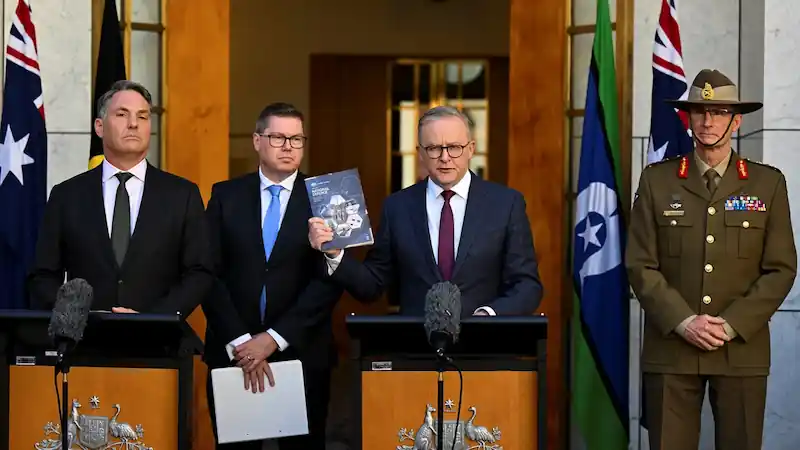


Australia has announced a major overhaul of its defense spending, marking the most significant review of its military preparedness since World War II. The country's emphasis will now shift towards long-range strike capabilities and the production of munitions domestically. Prime Minister Anthony Albanese revealed that this strategy aims to make Australia more self-reliant, prepared and secure, amid a growing perception of threat from an increasingly muscular China under leader Xi Jinping. The new defense strategy also calls for greater self-sufficiency, stronger relationships with allies and key powers in the region, including Japan and India, and a more defensive approach to stop adversaries from succeeding in their goals to coerce states via force.
Australia's remoteness had long fostered the assumption that any attack would come with a 10-hour warning. However, the rise of the "missile age" in modern warfare has radically reduced Australia's geographic advantages and the comfort of distance, as countries can now "project combat power" through assaults on supply routes and cyber warfare. The Covid-19 pandemic has also exposed Australia's vulnerability to global supply chains, highlighting the need for the country to become more self-sufficient.
The Defense Strategic Review recommended six priorities, including the development of a nuclear-powered submarine program, which was previously announced under the AUKUS deal with the United States and the United Kingdom. The review also suggested speeding up the acquisition of long-range strike missiles and manufacturing munitions within Australia, as well as improving defense cooperation with regional neighbors, particularly in the Pacific. The review also calls for upgrading the F-35A Joint Strike Fighter and F/A-18F Super Hornet aircraft to operate long-range anti-ship missile systems, while an urgent recruitment campaign is needed to boost the ADF workforce.
As part of the overhaul, funding for some programs will be cut, and plans to purchase 450 Infantry Fighting Vehicles have been slashed to just 129. Instead, the money saved will be spent on more HIMARS rocket systems and landing crafts, which will give the army greater mobility. This shift in priorities is expected to make Australia's defense procurement process more nimble, with a focus on streamlining strategically important projects.
This overhaul has come under criticism from some countries, particularly France, which was unhappy with the Australian government's cancellation of a $90 billion submarine deal in favor of the AUKUS program. However, the Australian government remains committed to its new strategy, which aims to make the country more self-reliant, prepared and secure.