


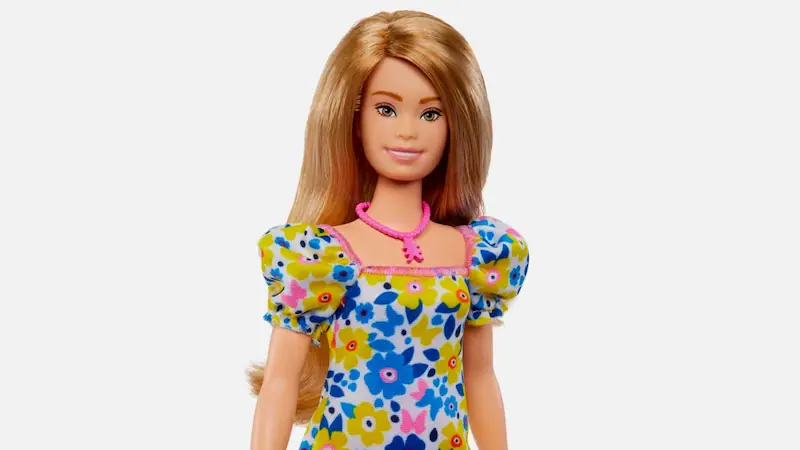


Mattel, the American toy manufacturer, has introduced its first-ever Barbie doll representing a person with Down syndrome. The new doll is part of the Barbie Fashionistas line, which aims to offer kids more diverse representations of beauty and fight the stigma around physical disabilities. The move follows the introduction of other Fashionista dolls that show diversity, including one with a prosthetic leg, another with hearing aids, and a doll with the skin condition vitiligo.
Mattel, which has faced criticism for giving girls a role model of a female body type with unrealistic proportions, has taken steps in recent years to embrace a more inclusive approach to its iconic Barbie brand. In 2016, as sales of the doll began to soften, Mattel introduced Barbie in four body types and seven skin tones, with 22 eye colors and 24 different hairstyles. The Fashionista line, which came three years later, continued this trend toward greater diversity and inclusivity.
For the newest Fashionista doll, Mattel worked closely with the National Down Syndrome Society (NDSS) to ensure that it accurately represents a person with Down syndrome. The genetic condition affects cognitive ability, causing mild to severe learning disabilities and distinctive facial characteristics. The new doll introduces a new face and body sculpt illustrative of women with Down syndrome, including a shorter frame and a longer torso. The face features a rounder shape, smaller ears, a flat nasal bridge, and slightly slanted eyes in an almond shape. Its palms include a single line, a characteristic often associated with those with Down syndrome.
The doll wears a pink ankle foot orthotic to match her dress, and her sneakers feature a zipper to represent children with Down syndrome, some of whom use orthotics to support their feet and ankles. The new Barbie’s puff-sleeved dress pattern features butterflies and yellow and blue colors, which are symbols and colors associated with Down syndrome awareness. The doll’s pink pendant necklace with three upward chevrons, a symbol that unites the Down syndrome community, represents the three copies of the 21st chromosome, which is the genetic material that causes the characteristics associated with Down syndrome.
Kandi Pickard, NDSS president and CEO, said in a statement, “This means so much for our community, who for the first time, can play with a Barbie doll that looks like them. This Barbie serves as a reminder that we should never underestimate the power of representation. It is a huge step forward for inclusion and a moment that we are celebrating.”
Lisa McKnight, Mattel’s executive vice president and global head of Barbie & dolls, said the company's goal with the doll is to “counter social stigma through play” and enable all children to see themselves in Barbie while also encouraging them to play with dolls who do not look like themselves. McKnight added, “Doll play outside of a child’s own lived experience can teach understanding and build a greater sense of empathy. We are proud to introduce a Barbie doll with Down syndrome to better reflect the world around us and further our commitment to celebrating inclusion through play.”