


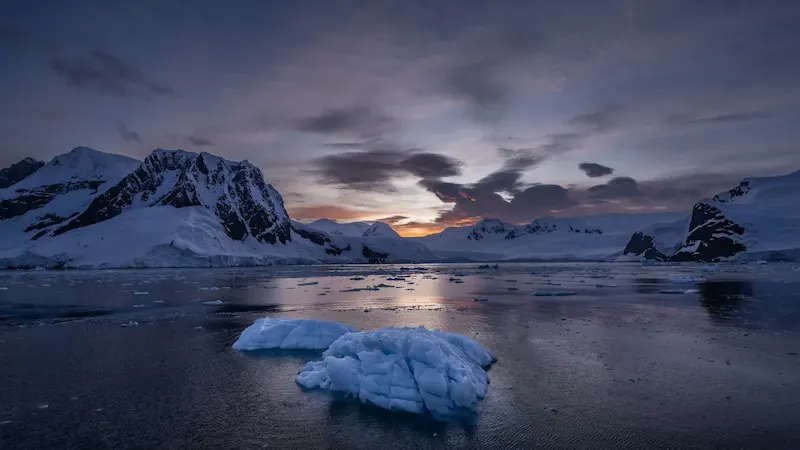


As the summer heat hits record-breaking levels in the Northern Hemisphere, a different climate record is being broken further south. The sea ice in Antarctica has reached unprecedented lows for this time of year. Typically, the sea ice shrinks to its lowest levels by the end of February and then builds back up over the winter. However, this year, scientists have observed a significant deviation from the expected pattern.
According to data from the National Snow and Ice Data Center (NSIDC), the Antarctic sea ice is currently at its lowest levels since records began 45 years ago. It is approximately 1.6 million square kilometers (0.6 million square miles) below the previous winter record low set in 2022. In mid-July, the sea ice in Antarctica was a staggering 2.6 million square kilometers (1 million square miles) below the average from 1981 to 2010, which is an area almost as large as Argentina or the combined areas of several US states.
This phenomenon has caught the attention of scientists, who describe it as off-the-charts exceptional. Some suggest that the occurrence is so rare that it may only happen once in millions of years. However, Ted Scambos, a glaciologist at the University of Colorado Boulder, explains that discussing the odds in terms of the previous system is not helpful. He claims that the game has changed, and it is evident that the system itself has undergone significant alterations.
Understanding the reasons behind this unprecedented sea ice loss in Antarctica has become a top priority for scientists. The Antarctic continent is vast, remote, and complex, making it challenging to comprehend its responses to global heating compared to the Arctic, where sea ice has experienced a consistent downward trajectory. Over the last few decades, Antarctica's sea ice has swung between record highs and lows, further complicating the analysis.
However, since 2016, scientists have observed a distinct downward trend in Antarctic sea ice levels. While natural climate variability does impact the sea ice, many scientists believe that climate change plays a significant role in the shrinking ice. Factors such as the strength of westerly winds around Antarctica, which are linked to planet-heating pollution, and warmer ocean temperatures mixing into isolated Antarctic waters are thought to contribute to the decline.
The implications of this diminishing sea ice are significant. Although the melting sea ice does not directly contribute to sea-level rise, it has indirect effects. With the disappearance of sea ice, coastal ice sheets and glaciers are exposed to waves and warm ocean waters, rendering them more susceptible to melting and calving. The loss of sea ice also has severe consequences for Antarctic wildlife, including krill, which is a vital food source for many whale species, as well as penguins and seals that rely on sea ice for feeding and resting.
Moreover, the disappearance of Antarctic sea ice has broader implications for the regulation of the planet's temperature. The reflective nature of sea ice allows it to bounce back solar energy, but when it melts, the dark ocean waters underneath absorb the sun's energy, contributing to further warming. Therefore, the decline of sea ice in Antarctica could have cascading effects beyond the continent's boundaries.
Various regions of Antarctica have already shown concerning changes. The Antarctic Peninsula, for example, is experiencing rapid warming and is one of the fastest-warming places in the Southern Hemisphere. Additionally, the Thwaites Glacier, also known as the "Doomsday Glacier," located in West Antarctica, is at risk of collapsing due to global warming. If this were to happen, global sea levels could rise by approximately 10 feet, with catastrophic consequences for coastal communities worldwide.
In light of the record-breaking low levels of sea ice observed this winter, scientists are deeply concerned. This significant deviation from previous years' patterns serves as a strong warning signal. Scambos asserts that the Antarctic system may not recover as it did in the past, suggesting a long-term change for the isolated continent. While some experts exercise caution and believe it is too early to determine if this is the new normal, the urgency to understand and address the unprecedented sea ice loss in Antarctica is evident.