


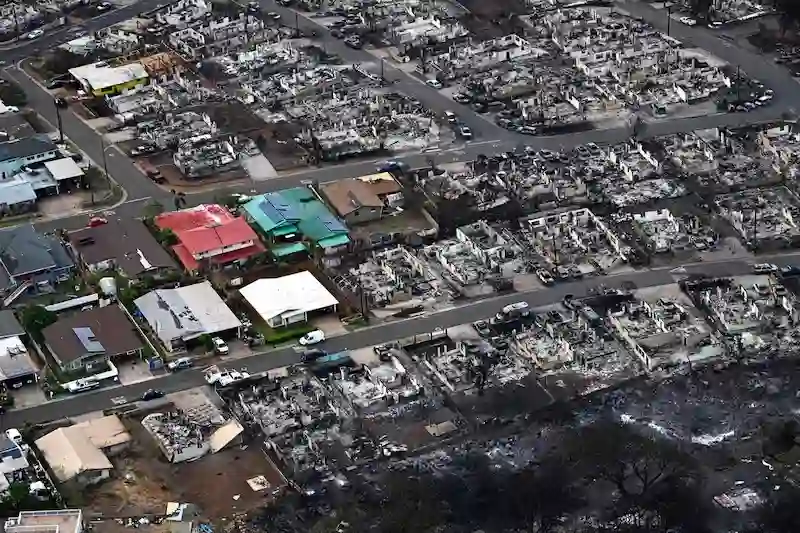


Hawaiian Electric Industries Inc. saw a significant drop in its stock price amidst concerns that its power lines may have contributed to the devastating Maui wildfires. Shares of the company plummeted by a record 39% on Monday morning, reaching a low of $19.90.
The utility company, which serves Maui, has faced criticism for failing to shut off power despite warnings from weather forecasters about dry and gusty winds that could create dangerous fire conditions. Plaintiffs attorneys are now focusing on Hawaiian Electric's equipment as a possible source of ignition and are planning to file lawsuits against the company this week.
While the cause of the wildfires has not yet been officially determined, authorities have not ruled out Hawaiian Electric's power lines as a potential trigger. The company, however, stated that it does not have any information regarding the possible cause of the fires. Hawaii Attorney General Anne Lopez announced on Friday that an investigation would be launched to examine how authorities responded to the wildfires, which claimed over 90 lives.
The finger-pointing has intensified towards the utility company, and this has led Wells Fargo analyst Jonathan Reeder to lower his price target for Hawaiian Electric. Under state law, negligence is determined based on the "reasonableness of care" standard, which may place a lower burden of proof on plaintiffs compared to a gross negligence standard.
The risk of power lines causing wildfires has increased with climate change, as hotter and drier conditions prevail in certain regions. Just last year, California's largest utility, PG&E Corp., filed for bankruptcy after its faulty equipment triggered devastating wildfires. Since then, power companies in California, Oregon, and Nevada have adopted preemptive power shutdown measures during high-risk weather conditions to prevent catastrophic fires.
Attorneys from various law firms, including Watts Guerra, Singleton Schreiber, and Frantz Law Group, have been gathering evidence and conducting interviews to build a case against Hawaiian Electric. Reports indicate that damaged equipment owned by the company may have been the source of the ignition that sparked the Lahaina fire.
Mikal Watts, a plaintiffs lawyer at Watts Guerra, stated that all available evidence, including videos, witness accounts, the progression of the fire, and remaining utility equipment, points to Hawaiian Electric's equipment as the ignition source for the devastating fire in Lahaina. Watts has previously secured significant settlements in other wildfire cases, notably against PG&E Corp.
The situation is complex in Maui, as shutting off power preemptively, like in other regions, is not as straightforward. Because Maui is a popular tourist destination, the implications of de-electrification may have different consequences. Mojtaba Sadegh, an associate professor of civil engineering at Boise State University, explains that compared to remote areas in California, the local residents of Maui might have a different perspective on power outages due to their familiarity with the situation, while tourists may not be as welcoming to such inconveniences while enjoying their vacations.