


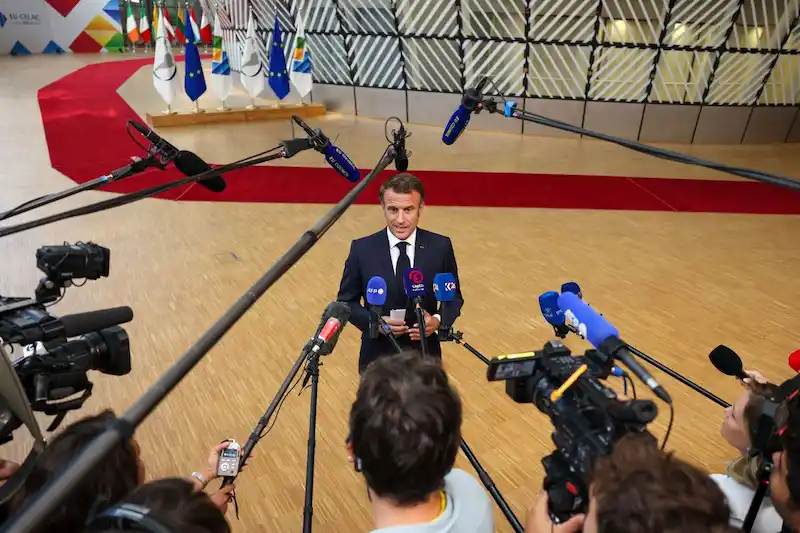


French President Emmanuel Macron has defended the government's decision to ban long flowing dresses called abayas in schools, stating that it was not intended to target Muslims specifically. In a recent interview with a popular YouTuber among young people, Macron explained that the enforcement of the ban on religious signs in schools was primarily driven by concerns raised by teachers regarding religious expressions in educational settings. He emphasized the need for schools to maintain neutrality, allowing students to focus on their education rather than their religious identity.
Macron clarified that his intention was not to stigmatize any particular group or individual. He stated that families and young girls who wished to wear the abaya needed to understand the rationale behind the decision. According to Macron, the move aimed to uphold the principle of secularism in French schools, where all faiths are respected but kept private. Nevertheless, critics argue that such measures can be weaponized to target Muslims, causing controversy and divisions within French society.
Just before the start of the new school year, Education Minister Gabriel Attal announced that the government would be increasing pressure against the wearing of abayas in schools. This move was in line with a 2004 law that already prohibited the display of visible religious signs in state-run educational institutions. France's approach to secularism is unique, aiming to maintain a neutral space where religious beliefs are private matters. However, this commitment to secularism has been a subject of debate, with activists claiming that it is used to discriminate against the Muslim community.
Moreover, France has previously banned face-covering clothing, which includes burqas and niqabs, in 2011. The issue of Islamic dresses and religious signs in public spaces has long been contentious in France, given its significant Muslim population. Critics argue that French policies targeting the Muslim minority are discriminatory, while supporters believe these measures are necessary to preserve the country's version of secularism.
Macron's stance on the issue of religious expression has been controversial in the past. Following the tragic beheading of a teacher in 2020, he responded by empowering the police and targeting mosques suspected of receiving illicit funds. However, these actions were criticized by some countries, such as Turkey, which accused France of targeting Muslims. This sparked a wider debate on issues of tolerance, the rule of law, and approaches to combating extremism.
In response to the ban on abayas, Saeedah Haque, a British abaya brand, has promised to reimburse the cost of abayas for girls in France who choose to wear them at school and record videos documenting their experiences.
While the ban on abayas and other religious signs in schools continues to generate debate and controversy, the French government maintains its position that the enforcement of secularism in educational institutions is necessary for the equality and neutrality of the education system.