


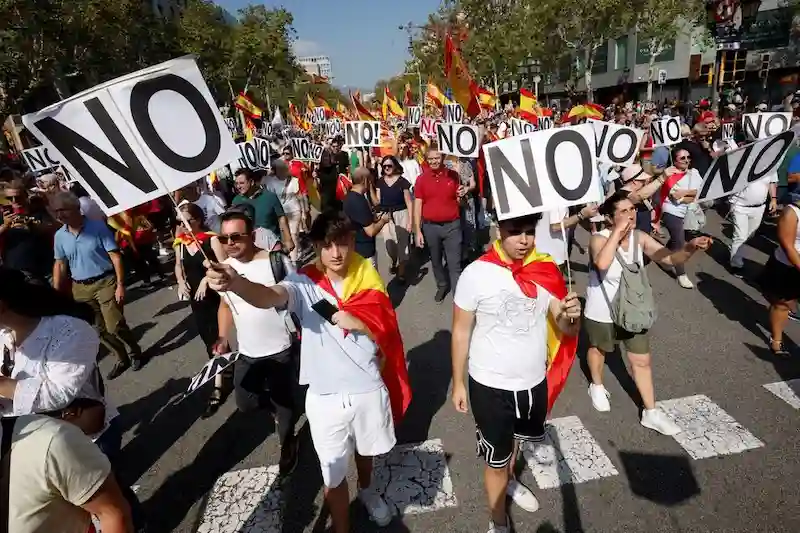


Tens of thousands of people flooded the streets of Barcelona on Sunday, proudly waving Spanish and Catalan flags, to voice their opposition against a potential amnesty deal. The amnesty, which is being sought by Spain's Socialists, is a crucial condition for forming a new government and stems from Catalonia's separatist bid in 2017.
The protest, organized by the anti-separatist group Societat Civil Catalana, took place just days after the acting Socialist prime minister, Pedro Sanchez, was nominated to seek support from other political parties. In order to secure the backing of the Catalan separatist parties Junts and Esquerra Republicana de Catalunya, the Socialists must promise an amnesty for those involved in the independence movement.
The march drew a substantial crowd, with an estimated 50,000 protesters in attendance, according to police. The rally was attended by opposition leaders such as Alberto Nunez Feijoo, leader of the conservative People's Party, and Santiago Abascal, leader of the far-right Vox party.
Protesters expressed concerns that an amnesty would undermine the judiciary system and place the government above democracy and the rule of law. Javier Tapia, a 55-year-old chemicals worker, stated, "An amnesty would put the government above democracy and the rule of law." Another protester, Isabel Martinez, asserted, "We cannot allow an amnesty because not all Catalans believe that these separatists should be pardoned. They want to live in conflict forever but we want to live in peace."
Sanchez has defended his conciliatory approach towards Catalonia, including the recent 2021 pardons granted to nine jailed separatist leaders, stating that the 2017 crisis had brought nothing positive. However, critics argue that the proposed amnesty is primarily a political move aimed at securing Sanchez's position as the country's prime minister.
If approved, the amnesty would potentially cover more than 1,400 individuals involved in the independence bid, as estimated by the pro-separatist Catalan group Omnium. This includes individuals currently in jail or facing charges. The proposed amnesty would be the largest in Spain since the 1977 blanket amnesty granted for crimes committed during the Francisco Franco dictatorship. Additionally, it would be the first amnesty law approved in the European Union since 1991, according to Spain's CSIC research council.
A mid-September poll indicated that approximately 70% of respondents were against the idea of an amnesty, with 59% of Socialist supporters expressing their opposition to the proposal. As the deadline for securing a majority by November 27 inches closer, if no candidate for prime minister is successful, the country would face the prospect of a repeat election.