


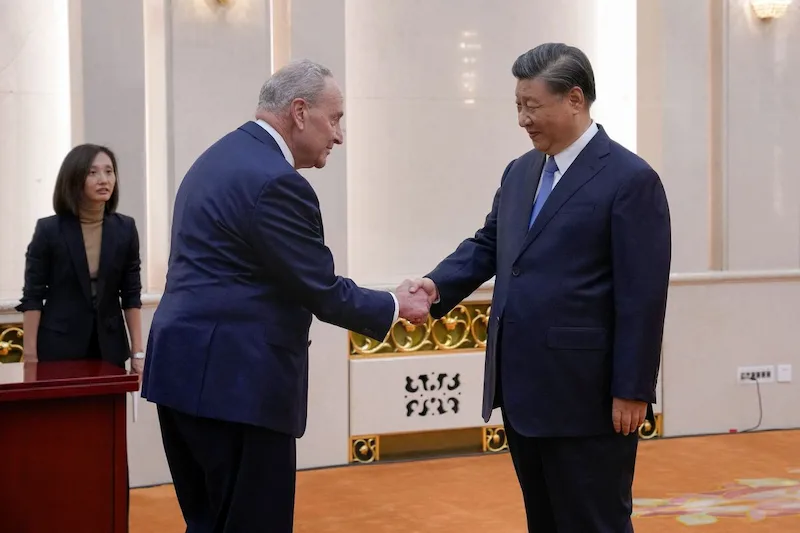


Amidst a world plagued by conflicts like the Israel-Hamas war and Russia's invasion of Ukraine, there is a glimmer of hope in the form of improving US-China ties. In recent months, President Xi Jinping's government has engaged with numerous US leaders, expressing a strong desire to strengthen the relationship. This positive trajectory will continue with the arrival of China's Foreign Minister Wang Yi in Washington to meet with President Joe Biden, paving the way for an anticipated leaders' meeting between Xi and Biden next month in California.
While China has not officially confirmed Xi's attendance at the meeting, the Chinese leader recently emphasized to the governor of California that their nations' interests are closely intertwined. This sentiment reflects a shifting perspective towards fostering friendlier ties ahead of the Asia-Pacific Economic Cooperation forum. China seeks a stable geopolitical environment to attract foreign investors amidst a slowdown in its own economy, while the US aims to address military and economic threats presented by China.
Chinese officials are well aware that there is a limited window of opportunity for improving relations before the US enters election mode, during which both Democrats and Republicans tend to adopt tough positions on China. Theresa Fallon, director of a Brussels-based research center, suggests that Beijing realizes the need to act swiftly.
Nonetheless, the US-China relationship remains fragile, given their opposing stances on conflicts in Europe and the Middle East, as well as trade curbs imposed by Washington to limit China's access to advanced technology. Even a seemingly positive meeting between Biden and Xi last year was swiftly disrupted by a spy balloon incident, underscoring the volatility of the situation.
A meeting between Xi and Biden, if it were to happen, would primarily hold symbolic importance. Dongshu Liu, a professor specializing in Chinese politics, suggests that Beijing is attempting to calm tensions between the two nations and stabilize the relationship. However, both sides understand that significant compromises are unrealistic due to domestic pressures.
The nadir of China's relationship with the US occurred in August 2022 when the then-US House Speaker Nancy Pelosi defied Beijing's warnings and visited Taiwan. Beijing responded by freezing top-level military dialogue, raising concerns about a potential conflict in the Taiwan Strait between the two nuclear-armed powers. Nevertheless, there have been recent indications of military ties being reestablished, with the US accepting an invitation to participate in the Beijing Xiangshan Forum. Although the US is sending a lower-level official, the symbolic invitation suggests that talks between US Secretary of Defense Lloyd Austin and Chinese officials may be possible.
Economic engagement between the two nations is also improving, with the establishment of new working groups on economic and financial topics. Dialogues have already commenced, and there is a notable shift in tone and practice. CEO Piyush Gupta of DBS Group Holdings Ltd. expressed encouragement at the progress made, particularly as Xi focuses on supporting China's long-term economic growth.
While there is progress, thorny issues such as China's support for Russia and its refusal to condemn Hamas' actions in Israel continue to strain the US-China relationship. These conflicts are likely to be high on the agenda during Foreign Minister Wang's visit. However, both nations' ties to leaders on opposing sides of these conflicts offer a potential point of collaboration. They could work together to prevent the situations from escalating into broader regional wars.
As Wang meets with US National Security Adviser Jake Sullivan, there is an opportunity for progress. Their prior discussions in Malta on issues concerning Taiwan and Russia, as well as Wang's substantial efforts in negotiating, hold the potential for a positive outcome. Richard McGregor, senior fellow for East Asia at the Lowy Institute, believes that the success of the meeting lies in whether Washington can persuade Beijing to establish guardrails in their head-to-head competition — particularly in terms of military competition.
While challenges persist, the growing engagement between the US and China signifies a desire to move beyond hostility and find common ground. By navigating these delicate issues, the two nations can begin to build a more stable and collaborative relationship, benefiting both their economies and the larger global community.