


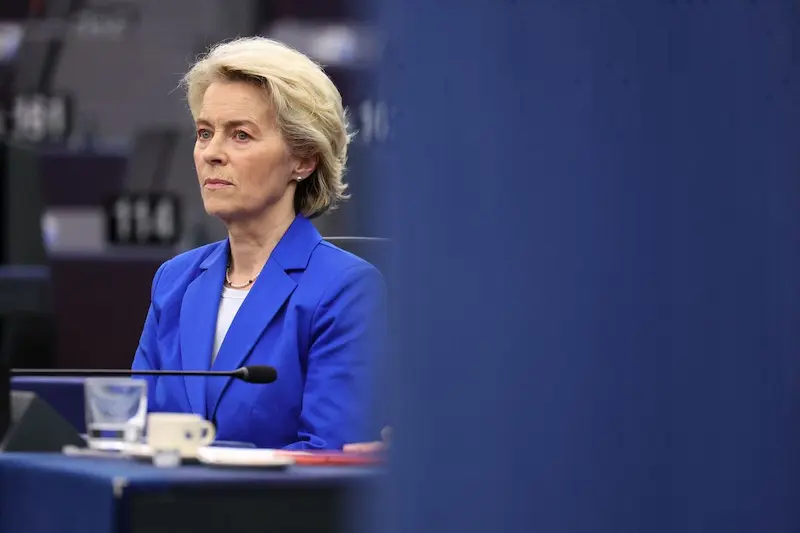


The President of the European Commission, Ursula von der Leyen, has called on Serbia and Kosovo to take significant steps towards normalizing their relations in order to progress towards European Union membership. In one of the most assertive statements made by a high-ranking EU official, Von der Leyen emphasized that Serbia must demonstrate a "de-facto" recognition of Kosovo, while Kosovo should implement a plan to grant ethnic Serbs a certain level of autonomy. These remarks were made during Von der Leyen's visit to the Balkan region on Monday.
Von der Leyen stressed the importance of both Serbia and Kosovo engaging and cooperating with one another, affirming that the normalization of their relations is vital for success and progress. Accompanied by Kosovo's president, Vjosa Osmani, Von der Leyen addressed reporters in Pristina and urged the two countries to make concerted efforts towards reconciliation.
Despite calls for improved relations, tensions between the Serbian President, Aleksandar Vucic, and Kosovar Prime Minister, Albin Kurti, have been escalating. To address this, European leaders, including German Chancellor Olaf Scholz, French President Emmanuel Macron, and Italy's Giorgia Meloni, met Vucic and Kurti in Brussels last week, urging them to ease tensions and resume talks. However, the meeting did not yield any significant breakthrough.
Kosovo, predominantly populated by ethnic Albanians, declared unilateral independence from Serbia in 2008, following a decade-long conflict that ended with NATO intervention. However, Serbia has consistently refused to recognize an independent Kosovo, as it considers it to be an integral part of its historical and cultural heritage.
Efforts to reach a breakthrough have proved challenging for EU and US diplomats, who have been grappling with finding a solution for the treatment of Kosovo's ethnic Serb population, particularly those residing in the northern part of the country.
During her Balkan tour, Von der Leyen stated that she will discuss Serbia's de-facto recognition of Kosovo with President Vucic. Additionally, she mentioned that the EU is considering lifting certain measures imposed on Kosovo in June.
One major hurdle in diplomatic efforts has been the fate of ethnic Serbs in Kosovo, who have received support from the Serbian government. In an attempt to incentivize progress, Von der Leyen promised the opening of EU markets to Kosovo, highlighting that the country's income currently amounts to approximately 27% of the EU average. She further emphasized the untapped potential and expressed the EU's commitment to doubling Kosovo's economy within a decade.
It is clear that Serbia and Kosovo must make significant strides towards normalizing their relations if they wish to progress towards EU membership. The calls from Ursula von der Leyen highlight the EU's unwavering commitment to facilitating a resolution between the two nations and promoting peace and stability in the region.