


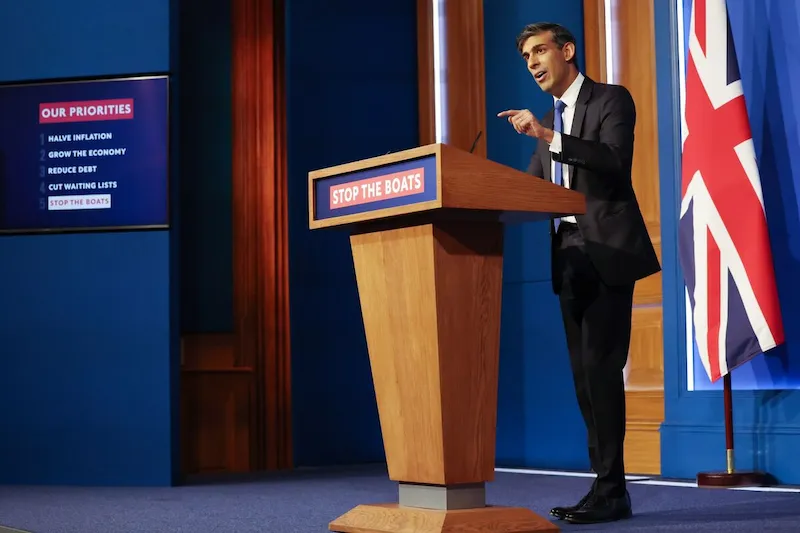


As 2023 comes to a close, Prime Minister Rishi Sunak finds himself facing an uphill battle to deliver on the promises he made to UK voters at the beginning of the year. In a speech in January, Sunak outlined five key pledges: halving inflation, growing the economy, reducing the national debt, shrinking National Health Service (NHS) waiting lists, and stopping migrants from crossing the English Channel in small boats. However, with a general election looming within the next 14 months and the Conservatives lagging more than 20 points behind the Labour Party in national polls, Sunak can only claim victory on one of his pledges.
Of the five promises, the only one that saw success was the goal of halving inflation. When Sunak made the pledge, inflation stood at 10.7%. Now, it has dropped to 4.6%, with forecasts suggesting it will end the year even lower. However, the Bank of England deserves credit for this accomplishment, as it maintained a strict monetary policy to combat inflation.
On the other hand, the promise that mattered most to voters, reducing NHS waiting lists, has not been met. Despite Sunak's commitment to reducing waiting lists, they have actually increased by half a million since the pledge was made. The prime minister has attempted to shift blame onto industrial actions taken by doctors and nurses, claiming that it is challenging to address backlogs when healthcare professionals are on strike. With junior doctors planning to strike again this month and in January, meeting the NHS waiting list goal before the election will be a significant challenge for Sunak and his government.
Another unfulfilled promise is the pledge to stop migrants from crossing the English Channel in small boats. While Sunak initially stated that new laws would be passed to accomplish this, the government has not been successful in stopping the flow of asylum seekers. Approximately 29,000 migrants have crossed to UK shores this year, showcasing the failure of the government's efforts. Moreover, the plan to deport migrants to Rwanda as a deterrent has been deemed unlawful on human rights grounds by the UK's top court. This setback has further complicated Sunak's promise and posed a potential challenge within his own party.
In terms of the national debt, Sunak's promise to ensure its reduction has proven to be ambiguous. Total debt has actually increased from 94.8% to 97.8% of GDP since January. The government's fiscal rules use a measure that excludes Bank of England liabilities, and by that measure, debt has grown from 84% to 88.6%. However, the OBR projects a slight decline in debt by 2028-29, meeting Sunak's promise. This is contingent on austerity measures in public services outside of health, education, and defense, as well as a high tax burden, which some think tanks deem implausible.
As the year comes to an end, Sunak finds himself with only one fulfilled promise out of the five he made to UK voters. With dissatisfaction growing over the state of public services after years of Conservative governance, his failure to meet the pledges on healthcare and immigration may impact voter sentiment. With a general election on the horizon, it remains to be seen whether voters will truly hold Sunak accountable and potentially turn to the Labour Party, led by Keir Starmer, as an alternative.