


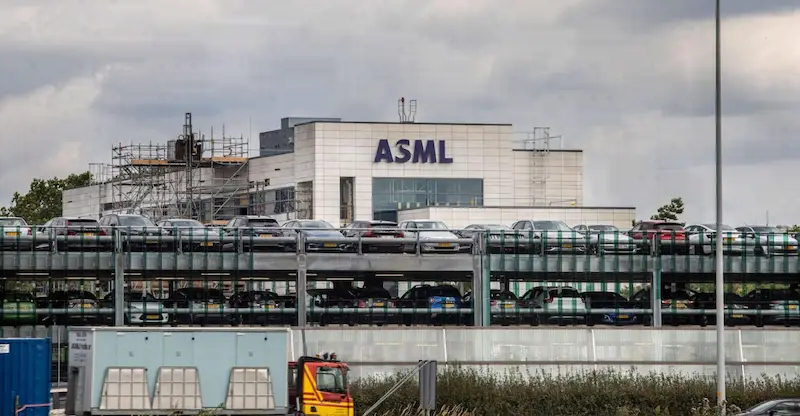


ASML Holding NV, a Dutch manufacturer of high-end chipmaking equipment, has reportedly canceled shipments of its machines to China at the request of the Biden administration, even before new export bans were implemented. The company had licenses to ship three state-of-the-art deep ultraviolet lithography machines to Chinese firms until the new Dutch restrictions take effect. However, US officials reached out to ASML and asked them to halt pre-scheduled shipments of some machines to Chinese customers, sources familiar with the matter stated on the condition of anonymity.
US National Security Adviser Jake Sullivan had reportedly contacted the Dutch government late last year regarding the issue. As a result, Dutch officials requested the US to directly communicate with ASML regarding the shipments. Following the US request, a limited number of machine shipments were canceled, although it remains unclear how many devices, each worth tens of millions of dollars, were involved.
The move reflects President Biden's efforts to curb China's attempts to establish its own advanced semiconductor industry, with the US and its allies imposing barriers to access imported technology. Last year, China's Huawei Technologies Co. manufactured a smartphone rivalling Apple's iPhone, using top-of-the-line chips made with ASML's immersion lithography machines.
ASML, Europe's largest technology company, confirmed that the Dutch government recently partially revoked licenses for the shipment of certain lithography systems to China, affecting a small number of customers there. The company acknowledged discussions with the US about the impact of export control regulations, but without providing further details. ASML noted that it does not anticipate any significant financial impact from the recent measures for 2023.
Spokespeople from the White House National Security Council and the Dutch Ministry of Foreign Affairs declined to comment on the matter. Meanwhile, a spokesperson for the Chinese Foreign Ministry condemned the US's intervention as an act of "hegemony" and called on the Dutch government to uphold contractual obligations and international order, while safeguarding mutual benefits.
News of the halted shipments caused shares of Chinese chipmakers to decline. Semiconductor Manufacturing International Corp. (SMIC), which aided Huawei in producing 7-nanometer processors for its smartphone, fell as much as 3% in Hong Kong trading. Hua Hong Semiconductor Ltd. also saw a drop of up to 2.8%.
This latest crackdown, potentially impacting SMIC, is expected to further propel Beijing towards accelerating the development of its own technology as it seeks to lessen reliance on international suppliers, according to analyst Gianmarco Bonacina from Equita SIM.
Pressure on ASML from the US began in 2019, when the Trump administration pushed the Dutch government to ban sales of the company's extreme ultraviolet lithography machines to China. ASML is the sole manufacturer of this particular technology, crucial for producing semiconductors powering smartphones and advanced military devices.
Under Biden's administration, the Dutch government tightened export controls on China last year, specifically targeting DUV machines, the second most advanced product line offered by ASML. China has been stockpiling these machines in anticipation of export controls. Chinese customs data reveals that China's imports of lithography machines soared more than five times between July and November 2021, reaching $3.7 billion. In the third quarter, China accounted for nearly half of ASML's sales, highlighting the rush by Chinese companies to import the equipment before the export controls were initiated.
ASML's CEO Peter Wennink, who is stepping down, has openly opposed these measures, warning that they may stimulate China to develop competing technology. He stated in an interview last year with Bloomberg News that "the more you put them under pressure, the more likely it is that they will double up their efforts."