


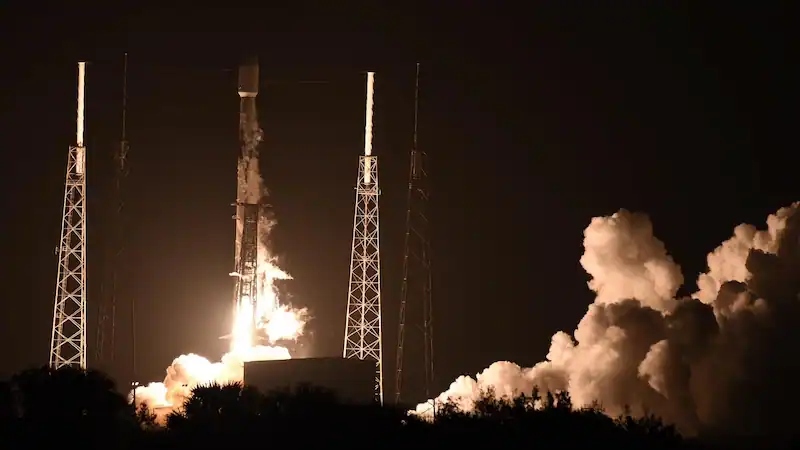


Japanese company Ispace attempted to make history on Tuesday by landing a lunar lander, carrying the first Arab-built lunar spacecraft, on the moon's surface. The vehicle was built as a commercial venture, unlike previous moon landings which were led by a single country. After months of travel, the lander was scheduled to touch down on the moon on Tuesday at 12:40 p.m. ET. However, contact with the spacecraft was lost during the landing attempt, leading Ispace to presume that the vehicle was lost. The company's CEO, Takeshi Hakamada, stated that the team would continue to investigate the situation, although they were able to gather data right up until the attempted landing.
The Rashid rover, which was built by the Mohammed bin Rashid Space Centre in Dubai, was carried by the lunar lander. It was equipped with high-resolution cameras and a "Langmuir probe" for sampling the plasma environment above the lunar surface. The rover was expected to explore the Atlas Crater on the northeast of the moon during the 14-day lunar daytime if the landing had been successful.
Only three countries, the United States, the former Soviet Union, and China, have ever executed a controlled landing on the moon. Ispace had been one of several companies that competed in the Google Lunar XPrize, which was cancelled in 2018. However, the company chose to continue pursuing the mission. The Google-sponsored competition had offered a $20 million reward to the company that could put a robotic rover on the moon, travel a couple of thousand feet, and transmit data back to Earth.
Ispace's future plans include a mission to retrieve lunar soil samples on behalf of NASA's Artemis program, which intends to use commercial lunar landers to explore the moon's surface. Although the lander was not able to complete its mission this time, Ispace's pioneering efforts in commercial lunar exploration will pave the way for future space exploration and development.