


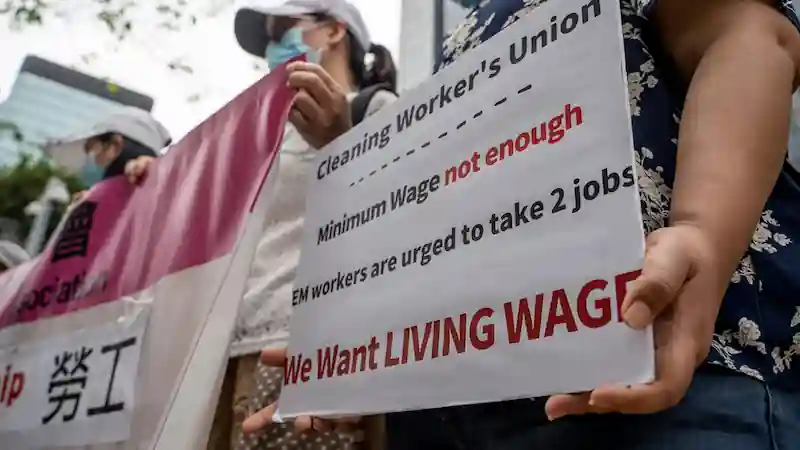


Hong Kong, one of the world's most expensive cities, recently raised its minimum wage by a mere 32 cents, which has been met with criticism from activists and community workers alike. The new minimum wage is now set at HKD 40 ($5.1) per hour, up from the previous HKD 37.5 ($4.78) per hour. However, this increase is not enough to cover basic needs in the city, according to Wong Shek-hung, director of the Hong Kong, Macau and Taiwan program at the charitable organization Oxfam.
While the minimum wage in Hong Kong is meant to be reviewed every two years, it was frozen at the previous rate in 2021 due to the Covid-19 pandemic, with authorities arguing that a wage increase would put additional pressure on enterprises and potentially result in job losses. However, the new increase is still lower than what a family of two would receive through the city's social security program and would demotivate workers, says Oxfam. The organization has urged the government to raise the minimum wage to at least HKD 45.4 ($5.78) an hour, calling the new increase "almost negligible."
Hong Kong's median hourly wage in 2021 was HKD 77.4 ($9.86), according to the Census and Statistics Department. In comparison, New York has a minimum wage of $15 per hour, and Los Angeles has $16.78 per hour. Singapore offers different minimum wages depending on the sector, applicable only for citizens and permanent residents.
The minimum wage does not apply to foreign domestic workers in Hong Kong, who are a crucial part of the city's economic and social fabric. They are required by law to live in their employers' households. The pandemic has devastated the food, beverage, hospitality, and tourism industries in Hong Kong, and the city's economic landscape has been further impacted by politics. The introduction of a sweeping national security law has led to the disbandment of various labor and trade unions, which have been vocal advocates representing hundreds of thousands of workers for decades.
The pandemic has also widened an already severe wealth gap in Hong Kong, with the richest households now making 47 times more than the poorest ones, according to a study by Oxfam released last October. The incomes of the poorest decile fell by over 20% compared to their incomes before the Covid-19 outbreak, and significant unemployment among those living in poverty has also been noted. The proportion of people living on minimum wage, made up mostly of workers in sanitation, cleaning, security, and retail, is actually lower now than a decade ago, said Wong. However, the gap between the median and minimum wages has increased, meaning that wealth disparity has gotten worse.
In conclusion, the minimum wage increase in Hong Kong is unlikely to make any substantial difference for workers in the city, given its high cost of living and severe wealth gap. While some small demonstrations have taken place to demand higher wages, the impact of the pandemic and national security law has made it difficult for labor and trade unions to effectively advocate for workers' rights.