


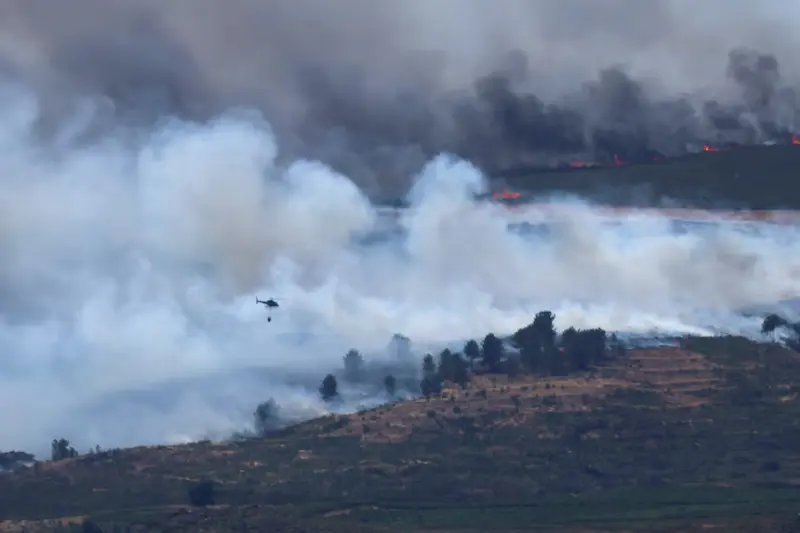


The summer of 2025 has unfolded across Europe in a way that feels both familiar and frighteningly new. Heat waves, four of them rolling in quick succession, have parched the land and set the stage for a season that has already been marked as the most destructive wildfire outbreak in nearly twenty years. The dry winds sweeping through hills and valleys have made the entire continent resemble a vast tinderbox, and flames have taken full advantage.
Satellite data from Copernicus paints a stark picture: almost nine thousand square kilometers of land have already burned within the European Union this year, a scale not seen since 2006. The speed with which fire activity surged this summer is striking. One more stretch of unseasonable heat, one more gust of hot, restless air, and fields, scrub, and forests that had been clinging to their last bits of moisture simply gave up. From Portugal’s rugged interior to the sun-drenched coasts of Greece and Albania, the same story keeps repeating — sudden flare-ups, whipped into raging fronts by winds too strong to stop.
Spain has become one of the hardest hit, a nation where firefighting planes still circle and more than forty blazes remain stubbornly alive. Over thirty-one thousand people have been forced to leave their homes in recent days, many not knowing whether they will have anything to return to. The government acknowledges that the flames have consumed more land than at any point since the mid-2000s. Police reports show dozens of arrests tied to fire investigations, though officials stress that negligence and arson are only part of the picture — the larger force at work is a climate that has turned merciless.
Prime Minister Pedro Sanchez is expected to travel to the provinces of Caceres and Zamora, regions now synonymous with devastation. There, the fires have triggered the broadest wave of international firefighting help Spain has ever received. Crews and equipment have arrived from countries as distant as Finland and Slovakia, a sign of how deeply the crisis resonates across borders. Forecasts promise cooler air and an end to the punishing sixteen-day heat wave, Spain’s third-longest in more than three decades. Yet officials warn that nearly half the country remains under “extreme danger” conditions for fires.
Just across the border, Portugal is living through its own nightmare. Temperatures may soon ease, but much of the country remains on high alert. Four major wildfires are still active, and one of them — burning near Trancoso — has already lasted more than a week. Unless halted, it could become the largest blaze the country has ever recorded. Nearly fifteen hundred firefighters are battling flames in different regions, a scene that has repeated itself daily this summer. Prime Minister Luis Montenegro has described the fight as a “war” and pledged support for devastated communities, though his delayed response and choice to keep political events on his schedule have drawn sharp criticism.
The wounds from Portugal’s 2017 tragedy, when over a hundred people perished in a single season of firestorms, have not healed. Those memories resurface each time smoke fills the sky, each time evacuation orders are issued too late or not at all. Some of the same regions that suffered eight years ago are burning again today. This repetition cuts deep into the national psyche, fueling not just grief but also anger toward leaders and institutions seen as failing to prevent history from echoing.
What is clear is that Europe’s fire problem is not a passing phase. The continent is warming faster than any other, scientists remind us, and summers like this may soon become the rule rather than the exception. Towns will rebuild, forests will recover, but each season seems to push the line of what is bearable further. What was once considered extraordinary is now alarmingly routine — walls of flame, mass evacuations, neighbors watching ash fall from the sky.
For many in Spain, Portugal, and beyond, this summer will not be remembered for beaches, festivals, or long warm evenings. It will be remembered for fire — for the weeks when the land itself seemed to burn without pause, and when Europe once again learned how fragile it really is in the face of a changing climate.