


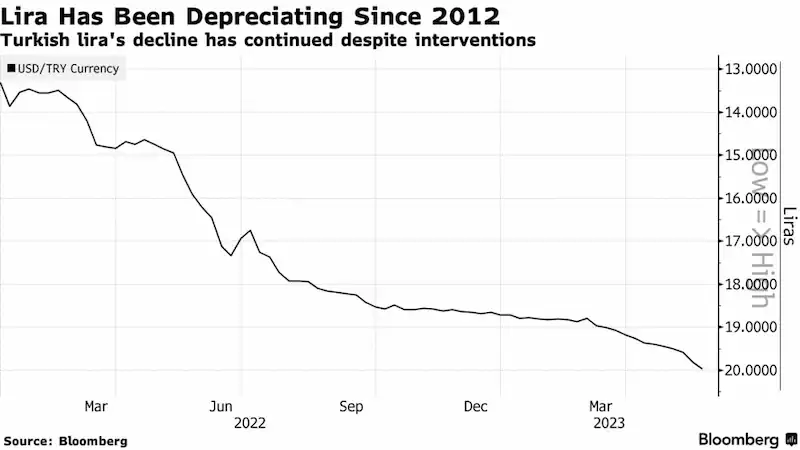


The Turkish lira faced a drop in its value towards a record low following the victory of current President, Recep Tayyip Erdogan, in the recent presidential runoff election. Erdogan’s extended tenure has earned him the title of the longest-serving leader in Turkey's history, which has further alienated foreign investors over time.
The stock market witnessed a jump while dollar bonds were seen mixed, as investors awaited hopeful appointment of Erdogan's new economic team, which he claimed would have "international credibility", hinting at a probable departure from the unorthodox policy that relied on ultra-low interest rates and heavy state intervention in markets. Reports suggest that Erdogan will announce his new cabinet as soon as Friday, according to two Turkish officials familiar with the matter.
The lira dropped 0.5%, nearing a record low at 20.0785 per US dollar around 1:55 p.m. in Istanbul, leaving Wall Street analysts to anticipate more weakness in the currency. Morgan Stanley warned of a possible 29% slide towards 28 per dollar by year-end if Erdogan doesn't change course while Wells Fargo & Co expected the currency to hit 23 by Q4’s end.
"An Erdogan win offers no comfort for any foreign investor," claimed Hasnain Malik, a strategist at Tellimer based in Dubai. "With very high inflation, very low-interest rates, and no net foreign reserves, a painful crisis affecting all assets could be on the way."
Erdogan’s unorthodox policies on interest rates that suggest lower rates lead to lower inflation have left the markets at the mercy of an unpredictable mix of ad hoc regulations and interventions, with new measures introduced on a near-daily basis. Such market regulations have led to investors fleeing, resulting in total foreign holdings of Turkish stocks and bonds declining by roughly 85%, or nearly $130 billion, since 2013.
According to Burak Cetinceker, a money manager at Strateji Portfoy in Istanbul, "it's obvious that the current economic model doesn't work." He further claims that Erdogan is probably aware of this, which makes a transition to an orthodox policy in the near future likely because it's not sustainable. Any positive signal towards this change would be encouraging to the market. Such policies have been quite expensive for the central bank, as it spent nearly $200 billion over the last year and a half to prop up the lira, resulting in net foreign exchange reserves turning negative, and inflation soaring above 80% last year before settling around 44% in April.
Traders have become more bearish than ever on the Turkish currency, as they believe market forces will eventually overpower government controls. According to risk reversals, the extra cost to protect against lira declines in the coming six months versus hedging against gains rose to a record 21.4 percentage points on Monday, doubling from 10.7 in January.
In the equity market, Turkey's benchmark index BIST-100 rose by almost 4.8% on Monday, with companies like glassmaker Sise ve Cam Fabrikalari and national carrier Turkish Airlines, contributing massively to this growth due to their foreign-currency income. The index was trading 3.8% higher as of 1:55 p.m. The appointment of new economic personnel, including the Ministry of Treasury and Finance, and central bank governors, is expected to be the first sign of any change in the policy mix. All current Ministers who have been re-elected must relinquish their parliamentary seats if given a cabinet position. The opposition's weak performance in the first round of the presidential elections on May 14 led to a significant surge in credit-default swaps, a more than 20% slump in banking stocks, and a decline in the Turkish lira.
Investment Director at Abrdn in London, Viktor Szabo, claims "some corrections need to be made to avoid running out of FX reserves at least." Policy announcements will also be crucial because "the current heterogeneous policies are unsustainable."