


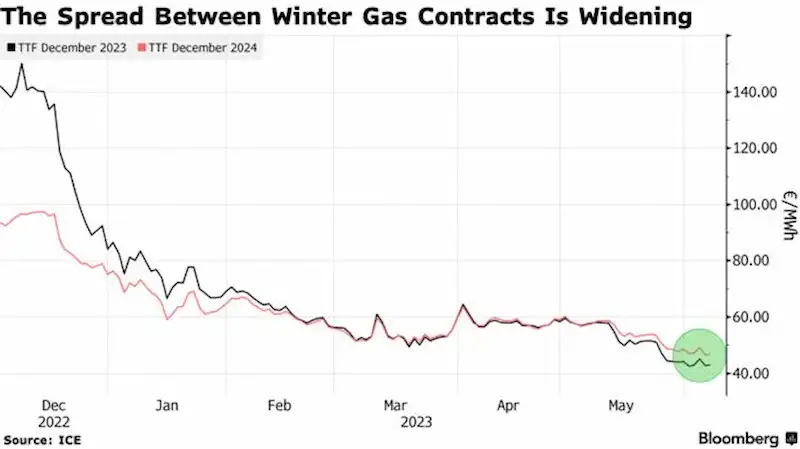


Europe's natural gas market is seeing a shift in dynamics, with the spread between prices for this winter and next showing a growing disparity. As per ICE Endex data, futures for December 2023 are currently trading at an approximate 8% discount to December 2024. This represents a reversal from the situation in January, where the nearest winter contract was trading at a premium. The trend suggests that Europe is well-prepared for the upcoming heating season following a mild winter, which allowed it to build up inventories with an inflow of liquefied natural gas (LNG). However, uncertainty at greater levels is likely still ahead.
The outlook for winter next year is deemed far more risky. Consultancy Inspired Energy's Director, Nick Campbell, says this is because it will be too soon to benefit from additional flows of LNG from the US (expected to come online starting 2026), and the region's mild winters are unlikely to continue indefinitely. While a cold winter this year could potentially lower storage balances ahead of next summer, there are other additional concerns. Notably, a gas-transit deal between Moscow and Kyiv reaches expiration in December 2024; this adds risk to the remaining Russian flows to Europe coming via Ukraine. Head of European Gas and Global LNG at Energy Aspects Ltd., James Waddell, points out that the last round of negotiations between the two parties took place at the last minute, with a deal reached only days before the previous one expired.
Any further disruptions to supply chains or prolonged winter spells could worsen the situation, resulting in European storage refill risks. However, Director of Global Gas Research at Wood Mackenzie Ltd., Kateryna Filippenko, indicates that as of now, Europe can still come close to meeting storage targets, relying on increased flows from North Africa and competing for limited LNG with Asia. This is still subject to change, as the market is expected to remain tight and vulnerable to price spikes until 2026 when new export plants in Qatar and the US come online.
Higher gas prices have significant ramifications for Europe's economy, limiting its ability to fight inflation. Looking ahead, traders are keeping an eye on the rate of China's economic recovery, which shares demand for LNG with Europe. Overall, the region's gas market is operating in a state of relative preparedness for immediate short-term demands. However, greater uncertainty lies ahead, making extended astute management of Europe's energy infrastructure critical to meet fluctuating demand pressures.