


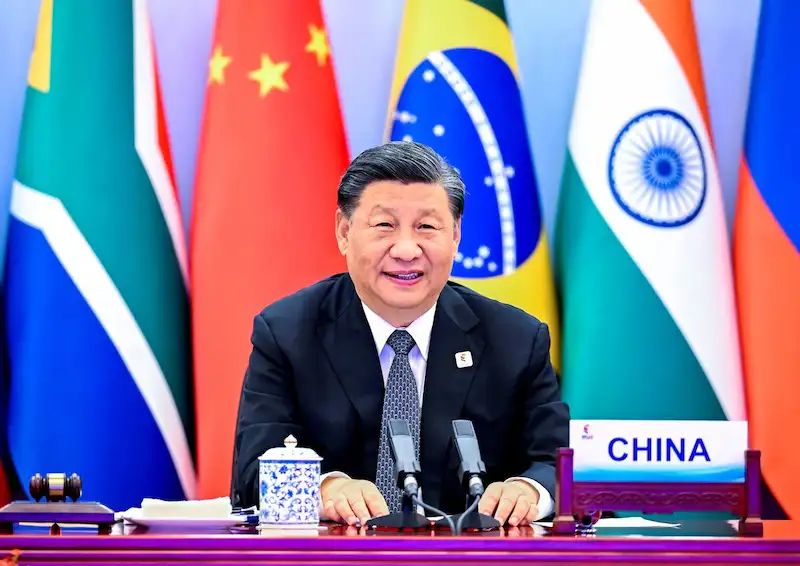


India and Brazil are resisting China's push to expand the BRICS group of emerging markets in an effort to grow its political influence and counter the United States, according to officials familiar with the matter. These objections have been raised during preparatory talks for an upcoming summit in Johannesburg, where the members of BRICS (Brazil, Russia, India, China, and South Africa) will gather to discuss the potential inclusion of Indonesia and Saudi Arabia. China has been lobbying for expansion during these meetings, but Brazil and India have expressed concerns.
The notion of expansion has sparked concerns in Brazil, as the country wants to avoid the group becoming a counterweight to the US and the European Union. On the other hand, India is in favor of strict rules to regulate the process of including new members without formally expanding the group. Any decision to expand will require consensus among the BRICS members, who will convene in August. India and Brazil are considering using the summit to discuss the possibility of bringing in additional countries as observers rather than full members.
China, however, has emphasized that the expansion of membership is a political consensus among the BRICS countries. The upcoming summit aims to showcase the group's ambition to establish itself as a significant political and economic force. While the potential establishment of a common currency has been discussed within BRICS, substantial progress on this front is not expected.
This summit occurs at a time of heightened tensions between the US and China, as well as concerns over the attendance of Russian President Vladimir Putin. Putin will participate virtually to avoid an International Criminal Court arrest warrant. However, BRICS members have refrained from blaming or sanctioning Russia over its invasion of Ukraine, even though the New Development Bank established by the group has frozen Russian projects.
Russia has no firm position on expanding BRICS but is not opposed to the idea, according to Fyodor Lukyanov, a Russian foreign policy advisor. The bloc, officially formed in 2009-2010, has strived to exert the geopolitical influence that corresponds to its economic power. The current BRICS members represent a significant portion of the global population, GDP, and trade.
Draft rules for admitting new members have been formulated after India opposed China's push for expansion. These guidelines are expected to be discussed and adopted at the upcoming BRICS summit. India has suggested that the group should consider emerging economies as well as democracies like Argentina and Nigeria for expansion, rather than Saudi Arabia, which has a dynastic and autocratic form of governance.
India's Prime Minister Narendra Modi discussed this matter with Saudi Arabia's Crown Prince Mohammad bin Salman last month. However, Saudi Arabia's government has not yet commented on the issue. Joining BRICS would support the crown prince's effort to diversify the Saudi economy, bringing the kingdom closer to Russia and China. Brazil, meanwhile, aims to avoid direct confrontation within the BRICS bloc and resist pressure from China to turn it into an antagonistic body challenging the G7.
Brazil has proposed the establishment of observer and partner country categories as a preliminary step before considering full membership for new nations. Brazil would support starting this process with Indonesia. China has continued to push for expansion in all preparatory meetings, including recent virtual meetings, according to a Brazilian official.