


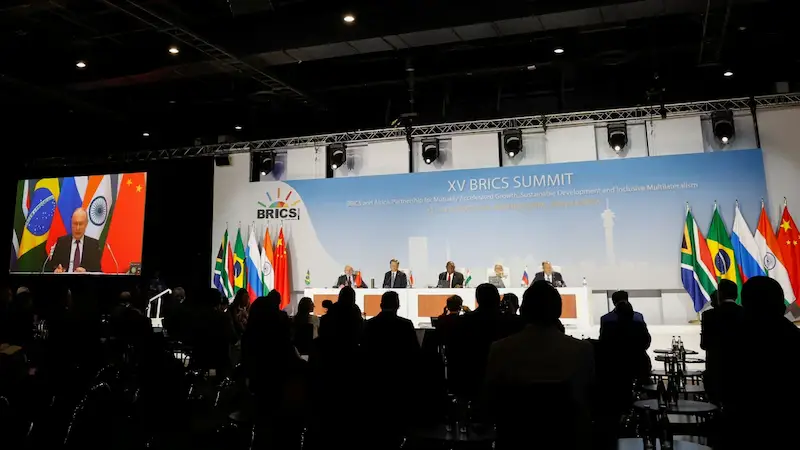


Saudi Arabia and the United Arab Emirates, major oil-producing countries, have been offered membership in the BRICS group of developing nations, marking the first expansion of the bloc in over a decade. Alongside them, Iran, Egypt, Ethiopia, and Argentina have also been invited to join, as announced by South African President Cyril Ramaphosa at the BRICS summit in Johannesburg. All six countries had previously expressed interest in joining the group. The BRICS group currently consists of Brazil, Russia, India, China, and South Africa.
The membership of the new countries will officially commence on January 1, 2024. Russian President Vladimir Putin lauded the expansion and expressed confidence in the increasing global influence of the BRICS bloc. Chinese President Xi Jinping described the move as historic and a testament to the group's commitment to unite and cooperate with developing nations. Indian Prime Minister Narendra Modi welcomed the expansion, emphasizing that it would strengthen the bloc.
The inclusion of Saudi Arabia, the world's largest crude oil exporter, into the BRICS group raises questions about potential collaborations between the oil giant and China, the world's largest oil importer. Additionally, the bloc's expansion brings together Russia and Saudi Arabia as members, both of whom are part of OPEC+, a major alliance of oil producers. This closer economic alliance could increase coordination between the two countries, creating an economic bloc that may challenge the influence of the United States.
The expansion of the BRICS group has also raised discussions about potential de-dollarization, as member countries may gradually shift away from using the US dollar for trade. Common currency discussions have also emerged within the group, although analysts consider the prospect of a shared currency in the near future unlikely.
The inclusion of openly anti-Western countries like Iran in the group has led to speculations that the BRICS bloc could tilt towards becoming an anti-Western alliance. As tensions between Russia, China, and the West escalate, the addition of these countries may further exacerbate the division.
The BRICS group was initially formed in 2009, with the inclusion of South Africa in 2010, and has continued to grow despite differences in political ideologies and economic systems among its members. The expansion is seen as a symbolic move, but some question the practical implications of adding more countries to the already diverse group.
The United Arab Emirates President, Mohamed bin Zayed al Nahyan, expressed appreciation for the country's inclusion in the important group. Egyptian President Abdel Fattah el-Sisi highlighted the opportunity for economic cooperation and amplifying the voice of the Global South as reasons for Egypt's enthusiasm in joining BRICS.