


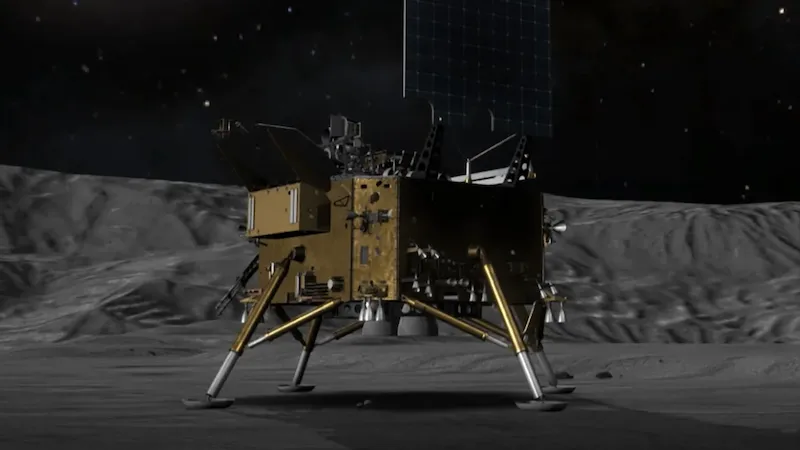


China's lunar mission to bring back the first samples ever collected from the moon’s far side is scheduled for next year, as Beijing continues to pursue its ambitious plans to send astronauts to the moon and establish an international lunar research station. The preparations for Chang'e-6, the next mission, are progressing smoothly, according to the China National Space Administration (CNSA).
In addition to Chang'e-6, CNSA is also looking ahead to its Chang'e-8 mission in 2028 and has called for increased global collaboration during the International Astronautical Congress. The Chinese expedition in 2028 aims to include joint "mission-level" projects with other countries and organizations, where collaboration could extend to spacecraft launch, orbit operation, spacecraft interactions, and lunar surface exploration.
The participation of international partners in the mission will be facilitated by allocating 200 kilograms (440 pounds) of payload space for foreign science instruments. This opens up the opportunity for overseas researchers to conduct lunar research in collaboration with China, using the mission as a platform for their experiments.
China's long-term goal is to construct a permanent international research station on the lunar south pole by 2040. The upcoming Chang'e-6 and Chang'e-7 missions, scheduled for 2022 and 2026 respectively, will contribute valuable data towards this objective. Beijing's efforts to establish itself as a major space power have already seen notable achievements, such as becoming the first country to land a rover on the far side of the moon in 2019, completing the construction of the Tiangong space station in 2020, and announcing plans for a manned lunar mission by 2030.
China's space program and lunar ambitions are not unique, as several countries are also focusing on the potential scientific benefits, national prestige, and access to resources that successful moon missions can offer. India recently became the fourth nation to land a spacecraft on the moon, while Russia experienced a setback with its lunar mission. The United States has launched its Artemis program and is actively seeking international partners for its mission to return astronauts to the moon and establish a scientific base camp.
With its upcoming Chang'e-6 mission, China aims to deepen our understanding of the moon's far side by collecting samples from the South Pole-Aitken Basin, which is a major lunar landform of high scientific interest. The mission will also carry payloads and satellites from international partners, including instruments from France, the European Space Agency, Italy, and Pakistan.
China's space exploration efforts, along with its focus on international collaboration, indicate its commitment to advancing the frontiers of knowledge and establishing itself as a key player in future space exploration endeavors.