


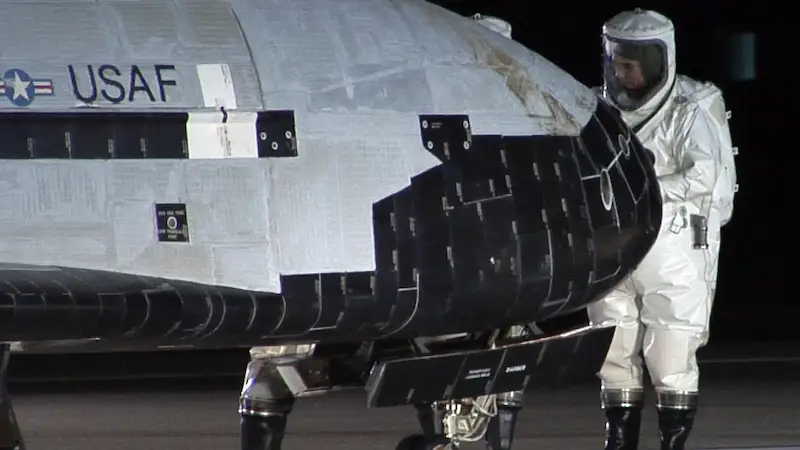


SpaceX is gearing up for an intriguing launch on Monday evening, as it prepares to send the enigmatic X-37B space plane into orbit. The US military's fascinating project is shrouded in secrecy, but it holds great significance as the country races to explore the depths of space. The X-37B, a robotic spacecraft resembling a miniature NASA shuttle, will embark on its seventh experimental mission. While many of its tasks remain classified, the US Space Force has disclosed some details about the objectives of this uncrewed mission.
The primary goal of the X-37B is to conduct experiments that will enhance our understanding of space operations and push the boundaries of what is possible. General B. Chance Saltzman, Chief of Space Operations for the US Space Force, has stated that these experiments will contribute towards improving ongoing and future space missions. Among the experiments onboard is NASA's Seeds-2 project, which aims to explore sustainable methods of supporting astronauts during long-duration space travel. The research will expose plant seeds to the harsh radiation environment to build upon previous findings from X-37B missions.
The X-37B's mission objectives also include testing the spaceplane in new orbital regimes, experimenting with future space domain awareness technologies, and investigating radiation effects on various materials, provided by NASA. Orbital regimes refer to specific areas in space where different celestial bodies exert the greatest gravitational influence. The military's reference to "new orbital regimes" suggests that the X-37B may be deployed into deeper space than previous missions, potentially into the cislunar regime encompassing Earth and the Moon.
This launch on Monday will mark the first time the X-37B will be deployed using a SpaceX Falcon Heavy rocket. Previously, it had been launched aboard the SpaceX Falcon 9 and the United Launch Alliance's Atlas V rocket. The Falcon Heavy, with its impressive power and thrust, will further enhance the capabilities of the space plane. Composed of three Falcon 9 rockets strapped together, the Falcon Heavy is currently one of the most powerful operational rockets in the world.
The duration of this particular mission is uncertain, but historical data suggests that each X-37B flight has been progressively longer than the previous one. The most recent mission concluded in November 2022, after the spacecraft spent a remarkable 909 days in space. During this sixth mission, the X-37B carried experimental technology developed by the US Navy to harness and transmit solar energy back to Earth. In recognition of its achievements, the X-37B was awarded the prestigious Robert J. Collier Trophy in August 2020, surpassing even the renowned Hubble Space Telescope.
The X-37B has already amassed an impressive track record, having spent over 3,700 days in space across its prior uncrewed missions. With each successful mission, the sophisticated and autonomous spaceplane continues to advance reusable spaceplane technologies while conducting crucial experiments that are returned to Earth for further analysis. As the United States seeks to expand its space exploration capabilities, the X-37B remains a pivotal asset in unlocking the mysteries of the cosmos.