


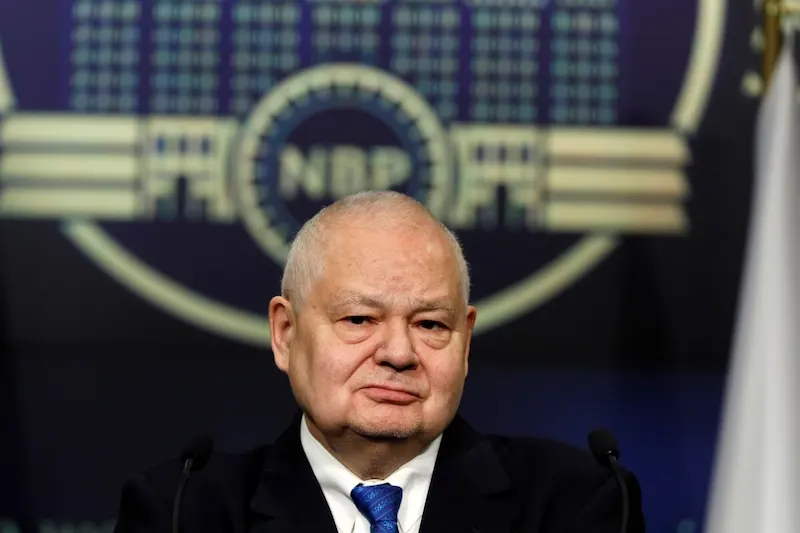


In a blow to Poland's new pro-European administration, the country's supreme constitutional court, which is dominated by judges appointed by the previous nationalist ruling party, has quashed Prime Minister Donald Tusk's plans to try the central bank governor. The ruling came just hours before the opposition Law & Justice party was set to hold a mass protest against Tusk's agenda.
Under the current rules, lawmakers are unable to suspend Governor Adam Glapinski, and the court has stated that a three-fifths majority would be required to pass a motion to pass. This is the same threshold as for cabinet members. The court argued that changes to the rules are necessary in order to protect the central bank's independence against interference from the ruling majority.
The government, which took office on December 13th, has been critical of Glapinski and has suggested subjecting him to the panel. However, Tusk has recently softened his position. The central bank has welcomed the ruling, with a spokesperson emphasising the importance of the independence of the governor and the central bank in line with other European central banks.
Tusk and his allies have accused Glapinski of engaging in political favouritism, irregularities in the bank's bond-buying program, and a failure to combat inflation. Glapinski has denied any wrongdoing. He has faced criticism in the past, particularly when he delivered an unexpected cut to interest rates ahead of the elections, leading to allegations that he was favouring the ruling party.
The ruling by the constitutional court has added to the political turmoil in Poland, eroding the country's chances of quickly accessing billions of euros in frozen European Union aid. This comes at a time when the country's assets were experiencing a significant rally after Tusk's victory in the October elections. However, the return of political instability has begun to test the resilience of these gains.
This ruling highlights the fragmentation in Poland's judiciary, as Tusk's administration faces challenges in reversing the changes made by the previous ruling party, which led to the suspension of significant EU aid. The Law & Justice party had sought to consolidate its control over the courts, media, and state institutions during its time in power, drawing criticism from the European Union for undermining the rule of law.
In a separate ruling, a chamber of Supreme Court judges, also dominated by Law & Justice appointees, confirmed the validity of the October elections, putting an end to the legal process examining the lawfulness of the ballot. With political risk continuing to reign supreme in Poland, the future for the country remains uncertain.