


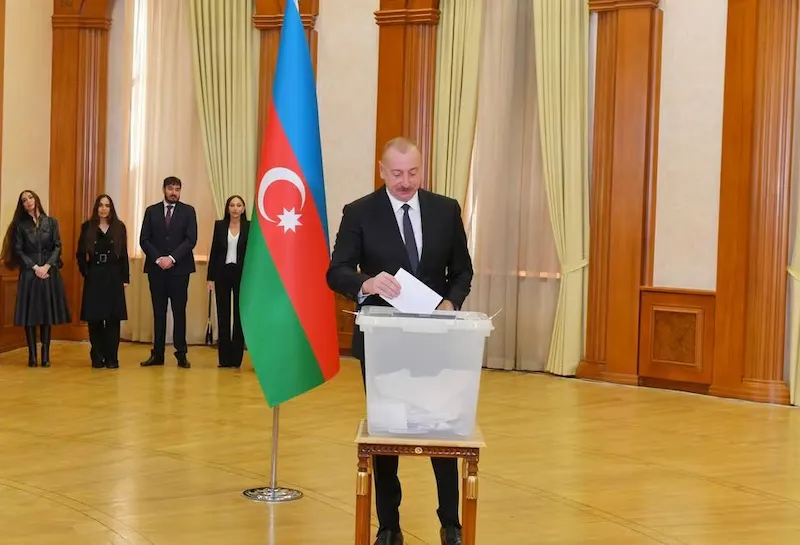


Azerbaijan's President Ilham Aliyev is set to secure a resounding victory in the country's re-election, as initial results show a landslide win. Following the recapture of the breakaway region of Nagorno-Karabakh from Armenia and a media crackdown, Aliyev called for early elections. With over half of the votes counted, the central election commission reported that Aliyev had garnered an impressive 92.1% of the cast votes, while an exit poll conducted earlier predicted he would secure 93.9% of the vote.
The two main opposition parties have boycotted the election in this oil and gas producing nation. Azerbaijan's energy resources hold significant importance in Europe's plans to reduce reliance on Russian gas after the Ukrainian conflict. Critics argue that past elections in Azerbaijan have been neither free nor fair, with Aliyev consistently securing over 85% of the vote. Azerbaijani officials, however, maintain that the current elections are fair and transparent, highlighting an increase in Aliyev's popularity following the victory in Nagorno-Karabakh.
Baku, as a close ally of Turkey and maintaining working relations with Russia, suggests that Western criticism is biased against its predominantly Muslim population. In January, President Aliyev, aged 62, stated that the snap polls marked the beginning of a new era for Azerbaijan, signifying the restoration of sovereignty after reclaiming Nagorno-Karabakh. Despite nominal rivals vying for the presidency, none of them are critical of Aliyev's rule.
However, concerns have been raised regarding the crackdown on dissent and independent journalists. Since November, a series of journalists have been arrested, with some facing charges of smuggling. International press freedom groups view these arrests as attempts to stifle anti-corruption reporting. The situation has sparked criticism from the international community, highlighting the importance of protecting the freedom of the press.
In December, Aliyev rescheduled the election from October 2025 to solidify his position following the successful retaking of Nagorno-Karabakh. This region, mainly populated by ethnic Armenians, had been de facto independent from Baku since the early 1990s after a war between Azerbaijan and Armenia. The restoration of Azerbaijani control over Nagorno-Karabakh is seen as a triumph for the country, ending decades of intermittent warfare and providing an opportunity for hundreds of thousands of internal refugees to return to their homes.
However, for neighboring Armenia, the collapse of Nagorno-Karabakh is viewed as a tragedy and a humanitarian crisis. Following the conflict, almost all of the region's 120,000 ethnic Armenian inhabitants fled to Armenia. The situation raises concerns about the plight of these displaced people and the resulting challenges Armenia faces in accommodating them.
As the election results continue to come in, President Aliyev's landslide victory seems all but certain. The international community will closely observe how this outcome will impact Azerbaijan's relations with neighboring countries and its commitment to promoting democracy and human rights within the nation.