


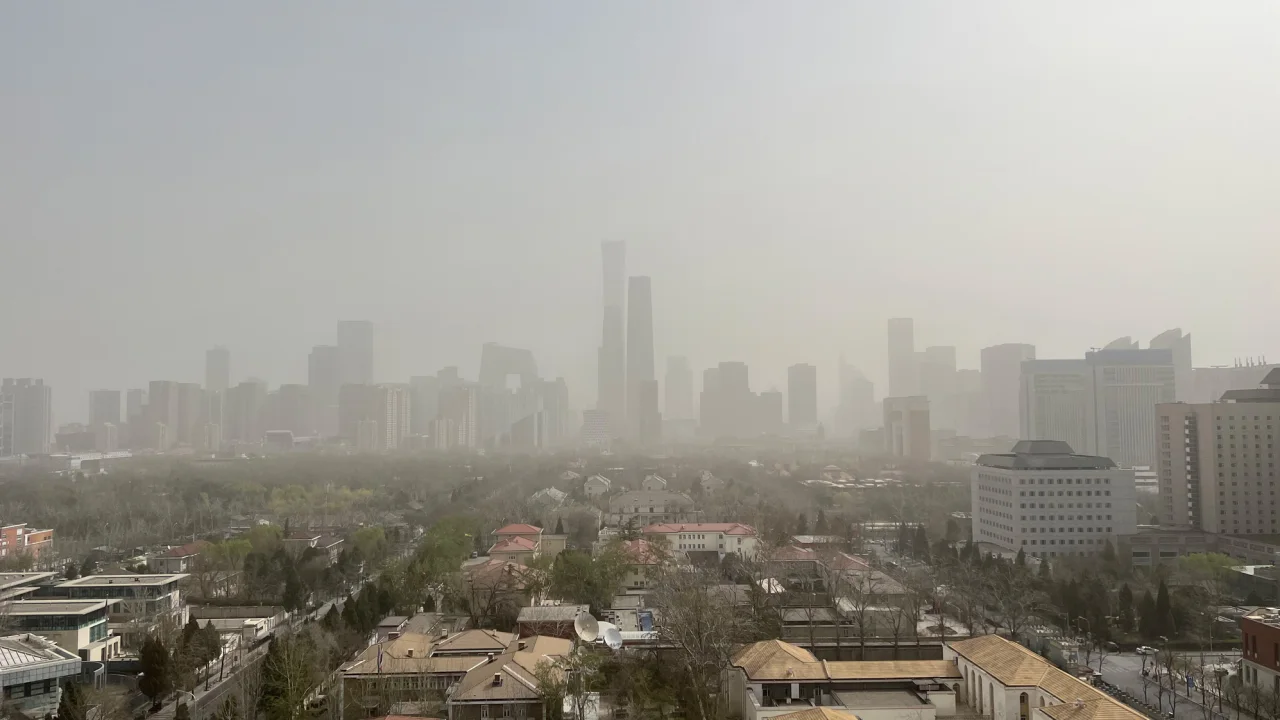


A sandstorm of unusual severity swept through Beijing and several northern provinces in China, causing the region to be enveloped in thick orange dust clouds and causing air pollution levels to skyrocket to dangerous levels, according to state weather authorities on Wednesday.
According to the Beijing Ecological Environment Monitoring Center, the Chinese capital was shrouded in dense clouds, with the air quality index for PM10, which refers to pollution particles that are less than 10 micrometers in diameter and can enter the lungs through the nose, exceeding the monitoring charts.
Due to low visibility caused by the sandstorm, Beijing's weather authorities warned people to avoid outdoor activities, including exercise, and advised drivers to drive slowly and carefully.
By 6 a.m. local time on Wednesday, PM10 particle concentrations had reached 1,667 micrograms per cubic meter, according to Beijing's monitoring center, which called it the most severe sandstorm of the year. This figure is more than 37 times higher than the World Health Organization's daily average guideline of 45 micrograms per cubic meter.
Beijing is frequently affected by sandstorms in the spring, exacerbated by rising industrial activity and extensive deforestation throughout northern China.
According to China's Meteorological Administration, nearly a dozen provinces, including Shaanxi, Shanxi, Hebei, Heilongjiang, Jilin, Liaoning, Shandong, Henan, Jiangsu, Anhui, and Hubei, issued yellow warning signals from Wednesday to early Thursday morning. China has a four-tier weather warning system, with red indicating the most severe warning, followed by orange, yellow, and blue.
According to Chinese weather forecasters, the current sandstorm originated in Mongolia on Tuesday and gradually moved toward central and eastern China. The lack of rainfall and low-pressure winds also resulted in sand particles drifting into the country.