


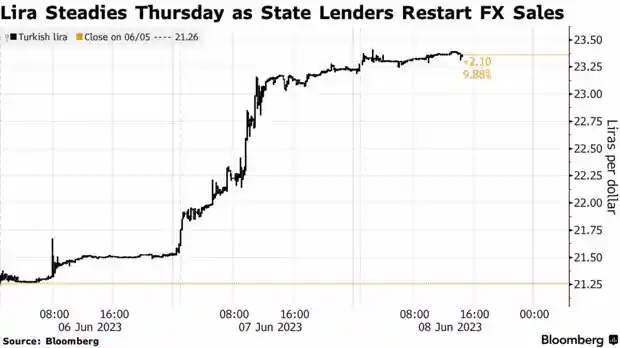


Turkish state-owned banks have once again stepped in to support the lira after the currency experienced its biggest drop in over a year on Wednesday. The lira has steadied on Thursday, trading 0.5% weaker at 23.37 as of 2:10 p.m. in Istanbul. The currency’s fall was much less dramatic than the previous day when state lenders stopped dollar sales and the lira weakened by 7%, the most significant drop since 2021.
The currency's devaluation followed President Recep Tayyip Erdogan's recent re-election, extending his two decades in power. Last week, Erdogan chose Mehmet Simsek, a former Merrill Lynch bond strategist, as his new finance minister, signaling that Turkey is set to shift from its long-held stance of heavy state interventions to prop up the currency.
After the state lenders reverted to this policy on Thursday, the cost of insuring against a Turkish default rose, implying unease among fixed income traders. Five-year credit default swaps widened for the first time this month, from 483 basis points to 516. A 2018 protocol between the Turkish Treasury and the central bank allows the latter to direct state lenders to sell foreign exchange.
According to sources familiar with the discussions, this week, the Treasury briefly stopped the protocol before reversing course to allow the interventions to resume. The central bank and the Treasury and Finance Ministry both declined to comment. Turkey’s state banks don’t comment on their foreign-exchange sales.
The central bank has expended billions of dollars of reserves trying to bolster the currency. As a result, the lira is down by 20% against the dollar this year, the most significant devaluation among major emerging currencies after Argentina's peso.
Experts attribute the lira correction to the realization by Turkish policymakers that their extensive use of reserves to defend the currency is not sustainable. Erik Meyersson, the chief emerging-market strategist at SEB AB, expects the lira to reach 27 by the end of the year.
Investors are also expecting moves towards more market orthodoxy with other institutions such as the central bank. The central bank, led by Governor Sahap Kavcioglu, has backed Erdogan’s calls to keep monetary policy loose. Since Kavcioglu assumed office in March 2021, the monetary authority has lowered its base rate from 19% to 8.5%. Meanwhile, inflation hovers at around 40%.
Hafize Gaye Erkan, a former banker at Goldman Sachs Group Inc. and First Republic, has emerged as a top candidate to replace Kavcioglu as the central bank’s governor. Investors expect a hike in interest rates at the central bank's next meeting on June 22 fueled by projections of a change in the top post.
Despite Erdogan's recent choice for finance minister and the expected market-oriented reforms, investors remain cautious. After so long espousing the benefits of unconventional monetary policies, many are unsure if Erdogan will allow a radical shift towards more orthodox policies. "There is a little glimmer of hope that Erdogan seems to have taken a turn toward sane monetary and fiscal policies," said Enrique Diaz Alvarez, chief risk officer at London-based Ebury. "But I need to see more to be convinced that Erdogan is executing a U-turn."