


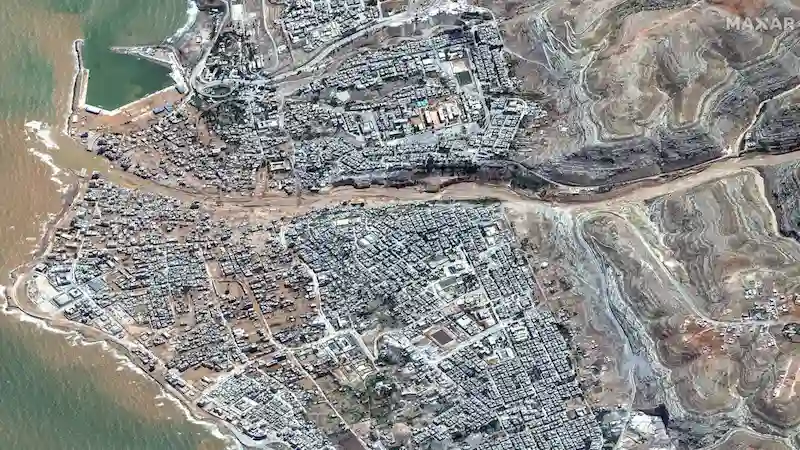


In the early hours of Monday, residents of Derna, Libya, were caught unaware as two dams burst, unleashing a devastating flood on the city. The wave of water swept through the mountains and quickly engulfed entire neighborhoods, leaving thousands dead and many more missing. According to Doctors Without Borders, at least 8,000 people have been killed, making this the deadliest flooding disaster in Africa in over a century.
Derna's population of around 100,000 was drastically reduced after the disaster, and authorities estimate that about 10,000 people are still missing. The destruction caused by the flood is immense, with buildings, homes, and infrastructure completely wiped out by the 7-meter wave that hit the city. Tragically, dead bodies are now washing up on the shore, according to the International Committee of the Red Cross (ICRC).
While the storm, known as Storm Daniel, also affected Greece and other countries, Libya experienced far greater devastation. Experts suggest that this is due to a deadly combination of factors, including aging and crumbling infrastructure, inadequate warning systems, and the impacts of the accelerating climate crisis.
Storm Daniel, classified as a "medicane," gained strength after passing through Greece, Turkey, and Bulgaria. It crossed the unusually warm Mediterranean waters and unleashed torrential rain on Libya. Al-Bayda, a city near Derna, experienced a new record of over 16 inches of rainfall in just 24 hours. Although it is too early to definitively link this storm to climate change, scientists believe that warmer oceans and a more moisture-filled atmosphere due to climate change contribute to the intensification of extreme weather events like storms.
Derna has a history of flooding, with at least five deadly floods recorded since 1942. The two dams that burst during this disaster were built over 50 years ago and have not undergone maintenance since 2002. Research conducted by Libya's Sebha University raised concerns about the dams' potential for flood risk and called for regular maintenance to prevent catastrophic flooding. The lack of vegetation to prevent soil erosion in the surrounding areas was also highlighted.
The infrastructure in Derna has been severely impacted by years of fighting, starting with the battle against ISIS and later the conflict with eastern commander Khalifa Haftar and his Libyan National Army. The city's infrastructure was already in a state of disrepair, further exacerbating the devastation caused by the floods.
Inadequate warning systems also played a role in the high casualties in Derna. The head of the United Nations' World Meteorological Organization, Petteri Taalas, stated that better warnings could have led to successful evacuations and prevented most of the human casualties. However, the political instability in Libya has hindered efforts to improve these systems.
Even with robust early warning systems, dam failures remain difficult to forecast. The speed and ferocity of a dam failure can result in catastrophic damage, making it one of the worst types of floods. Climate change further amplifies the risks associated with extreme weather events, such as unexpected heavy rainfall. The global infrastructure, including dams, buildings, and water supplies, is ill-prepared for these increasing climate-fueled extreme events.
In conclusion, the deadly flood disaster in Derna, Libya, was a tragic outcome of a combination of factors, including aging infrastructure, inadequate warnings, and the impacts of climate change. It serves as a stark reminder of the urgent need to address these issues and invest in resilient infrastructure to mitigate the devastating consequences of extreme weather events.