


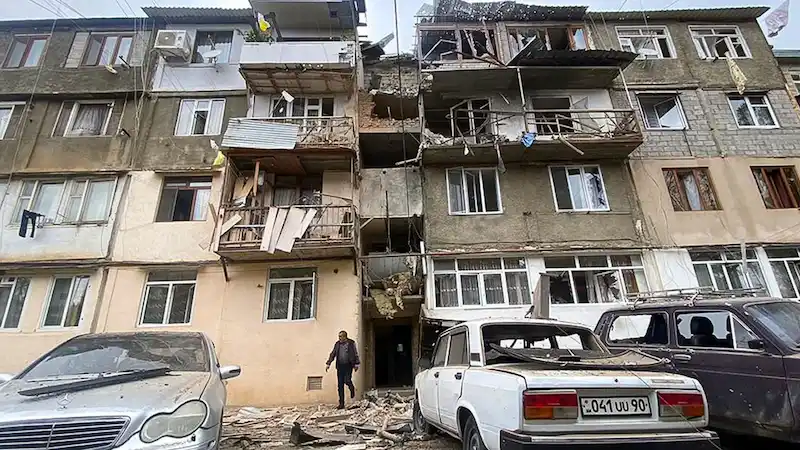


On the same day that Azerbaijan celebrated the surrender of separatist Armenian fighters in Nagorno-Karabakh, many residents in the breakaway region's capital, Stepanakert, engaged in a peculiar activity. They were seen burning stacks of paper, fearful that any documentation linking them to the de facto government would lead to persecution under Azerbaijani rule. While the recent ceasefire may have put an end to the bloody conflict fought for control of the region, there are growing concerns about the potential humanitarian crisis that may follow. Azerbaijan has expressed its intention to "reintegrate" Nagorno-Karabakh, raising questions about the fate of the region's ethnic Armenians and the possibility of violence or mass exodus.
It is no secret that Azerbaijan aims to regain full control of Nagorno-Karabakh, an enclave that has been under the control of Armenian separatists for decades, despite being internationally recognized as part of Azerbaijan. Previous wars and multiple ceasefire agreements have shown that lasting peace is not easily achieved in this region. The recent agreement between the two sides goes even further, with Nagorno-Karabakh agreeing to the complete disarmament of its armed forces. Azerbaijani officials, however, demand additional measures, including the dissolution of the de facto government ruling over Nagorno-Karabakh.
Azerbaijan's President, Ilham Aliyev, has made it clear that Karabakh officials have a choice to make - to fully integrate into Azerbaijan or face the consequences. Discussions between Baku and Karabakh officials have taken place, focusing on humanitarian issues and the need for essential supplies like fuel and food. The Azeri delegation has assured that these requests will be met. A notable concern, however, centers around the potential reintegration process and its consequences. Armenian Prime Minister Nikol Pashinyan and international experts have repeatedly warned of potential ethnic cleansing of the Armenian population in the enclave.
Adding to their distress, Nagorno-Karabakh has been under blockade for several months, with a military checkpoint preventing the import of food and leaving residents vulnerable to starvation. Humanitarian organizations and foreign media have been unable to access the region, making it difficult to verify reports of attacks and the movement of civilians. Reports of intense shelling and sieges in various villages paint a grim picture of the situation. Thousands of Karabakh residents have already fled to the airport where Russian peacekeepers are stationed.
For those ethnic Armenians who choose to stay behind, uncertainty and fear loom large. While some have made up their minds to evacuate, the question remains as to who will facilitate their departure if the blockade is eventually lifted. Moreover, concerns arise regarding possible detention or persecution for those men who participated in past conflicts or held positions in the de facto authorities. The situation is complex and disorganized.
There is also speculation about where Karabakh Armenians could potentially go if they are able to evacuate. The Government of Armenia has stated that it does not intend to displace them, instead believing in their right to live safely and with dignity in their homes. If such safety is deemed impossible, other decisions may need to be made, although no specifics have been provided.
The issue at hand is how Azerbaijan plans to dismantle existing institutions in Nagorno-Karabakh and establish its own. The region has a longstanding history of autonomy, having been self-governed as a de facto state. Tearing down existing institutions without any integration efforts could jeopardize future peace-building efforts. Furthermore, it is widely believed that Azerbaijan would resort to force if the Armenians in the enclave refuse to accept Azerbaijani citizenship. This raises concerns about the potential for further violence and the displacement of Armenian communities from the region.
In the best-case scenario, there may be symbolic integration efforts, reminiscent of a Potemkin village, aimed at impressing the international community. However, in the long run, systematic demographic engineering may be employed to push out the Armenian communities from the region. The situation remains uncertain, with the lives of Nagorno-Karabakh's ethnic Armenians hanging in the balance.