


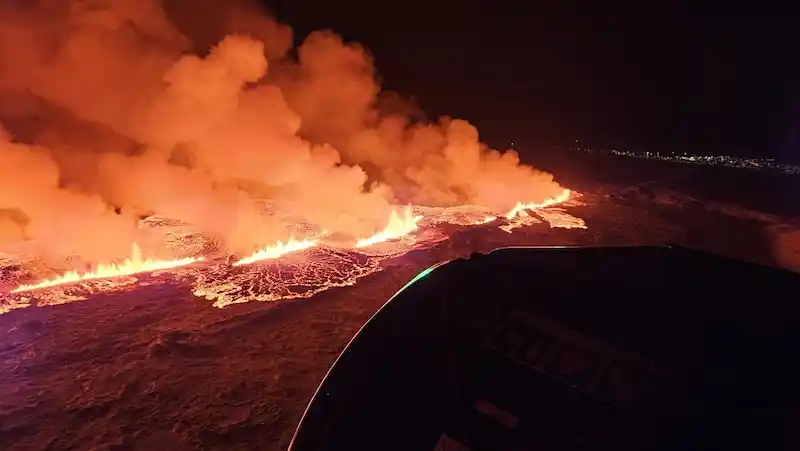


In a territory known for its volatile volcanic activity, Iceland is currently facing a renewed eruption that is causing significant damage and destruction. For the first time in more than half a century, homes are being destroyed as lava flows reach the outskirts of the fishing town of Grindavik, setting houses ablaze.
Live footage by public broadcaster RUV captured at least two buildings engulfed in flames on Sunday afternoon, following the opening of fissures that emitted lava earlier in the day. These lava vents are situated in the Reykjanes peninsula, approximately 40 kilometers (25 miles) away from the country's capital, and near the location of a three-day eruption in December.
While Iceland is no stranger to volcanic eruptions, the current event poses a threat to inhabited areas on a scale not witnessed since 1973. Back then, part of a town with a population of around 5,000 was buried under lava in the Westman Islands, off the south coast of the country.
Although the eruption in Grindavik is causing significant damage to the town's infrastructure, the good news is that all inhabitants had been evacuated prior to the eruption. People who had returned since a previous evacuation in November were safely relocated, according to Hjordis Gudmundsdottir, a spokesperson from Iceland's Department of Civil Protection and Emergency Management. Therefore, no lives are currently in danger.
Despite the ongoing eruption, flights in and out of Iceland are operating as usual and are expected to continue without interruption. This is consistent with previous volcanic incidents in the country.
The extent of destruction that Grindavik will face remains uncertain and highly dependent on the duration of the eruption. According to Benedikt Ofeigsson, a geophysicist at the Meteorological Office, the situation is unpredictable and ongoing measurements indicate that activity at the eruption site is easing. However, the level of uncertainty remains high.
There are currently two rifts open north of the town of Grindavik. One of them runs across a protective rampart that was under construction to shield the town, while the other rift lies within the barrier.
Earlier, a similar embankment had been completed to safeguard Iceland's renowned tourist attraction, the Blue Lagoon spa, as well as the Svartsengi power plant operated by HS Orka hf. The power plant, which provides heat to approximately 30,000 residents of the peninsula, is still operational.
Prior to the volcanic activity that began in early 2020, the area had been dormant for nearly 800 years. However, intense seismic activity led to the emergence of magma in 2021, resulting in the current eruption being the fifth since then.
Iceland, aptly nicknamed the "land of fire and ice," is located between the North American and Eurasian tectonic plates on the mid-Atlantic ridge. It boasts around 30 volcanic systems and more than 600 hot springs, making it one of the most geologically active places on the planet.
Although fatalities caused by eruptions are rare in Iceland, one person is currently missing in Grindavik after being presumed to have fallen into a deep crack formed during recent seismic activity.
In recent history, one of the most disruptive volcanic events in Iceland occurred in 2010, when the Eyjafjallajokull volcano erupted, releasing a massive ash plume that halted air traffic across Europe for weeks. The eruption resulted in the cancellation of around 100,000 flights and affected over 10 million people.