


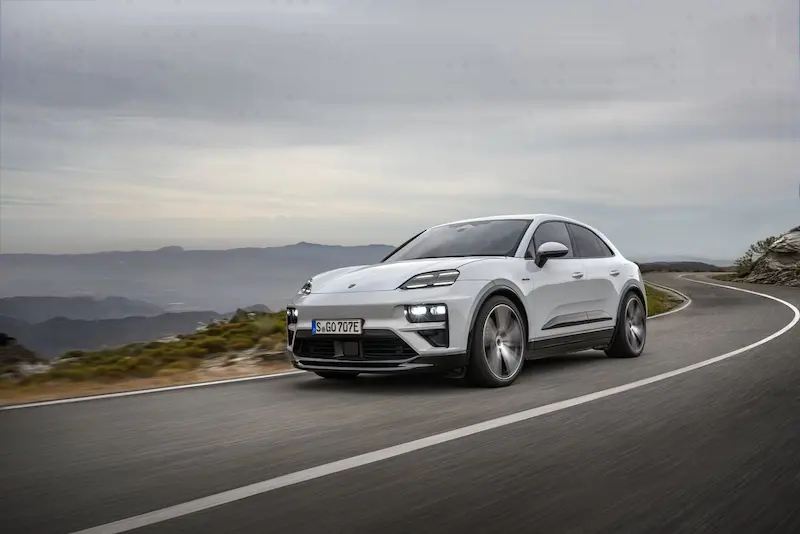


Porsche AG has unveiled its much-anticipated electric Macan SUV, marking its foray into the luxury electric vehicle (EV) market. With the EV market showing signs of cooling and consumers facing challenges such as higher borrowing costs and inadequate charging infrastructure, Porsche aims to gauge the appetite for luxury EVs with this new model. Priced at €84,100 ($91,593) and launched in Singapore, the success of the electric Macan will be crucial for Porsche as it strives to address its poor stock-market performance and slowing business in China, where it faces competition from Tesla, BYD, and BMW.
The electric Macan is Porsche's second electric car after the Taycan, which was unveiled in September 2019. The launch of the Macan was delayed by approximately two years due to software issues, which also contributed to the ouster of Volkswagen AG's then CEO, Herbert Diess. However, despite the challenges, Porsche hopes to replicate the popularity of its combustion-engine Macan, which outsold every other Porsche model in 2023, except for the larger Cayenne. Nevertheless, Porsche has cautioned that its overall sales volumes for the year are expected to remain flat.
The electric Macan, which is set to start deliveries in the second half of this year, competes with BMW's iX and Tesla's Model X. It is the first Porsche model to utilize a new electric vehicle platform that promises more efficient and flexible production. Developed in collaboration with Audi, this PPE platform will also be utilized in future models, including a battery-powered Cayenne.
"This is the bookend of what's to come," commented HSBC analyst Mike Tyndall. The success of the electric Macan will likely set the stage for Porsche's forthcoming EV launches. However, the prospects for 2024 may be challenging, as Germany, Porsche's home market, teeters on the brink of recession and global supply chains are disrupted due to turmoil in the Red Sea.
In China, Porsche's key market, the automaker expects conditions to remain difficult after experiencing a 15% decline in deliveries last year due to the country's economic slowdown. Porsche faces more significant exposure to macroeconomic forces compared to other luxury manufacturers like Ferrari, which operates on a scarcity business model with an order book spanning several years.
The electric Macan will be available in two versions: the base Macan 4, which can accelerate from zero to 100 kilometers per hour in 5.2 seconds, and the more powerful Turbo model starting at €114,600, which achieves the same acceleration in a remarkable 3.3 seconds. These electric SUVs offer driving ranges of up to 613 kilometers and 591 kilometers, respectively, and can recharge 70% of their battery in just 21 minutes. They boast an augmented-reality display that projects navigation cues directly into the driver's field of vision, enhancing the driving experience.
The launch of the electric Macan is particularly significant in the European Union (EU), as the combustion-engine Macan will cease sales in the region later this year due to regulations related to IT security, which it cannot comply with. However, Porsche will continue to offer the fuel-powered version outside the EU.
In an effort to highlight the environmentally friendly aspects of the electric Macan, Porsche has incorporated features such as leather-free seats and recycled materials like Econyl, made from regenerated nylon, in the vehicle's interiors. However, it is worth noting that the electric Macan is approximately 850 pounds heavier than its combustion-engine counterpart. Both versions offer all-wheel drive, lower seating positions, longer wheelbases, and larger storage spaces compared to the gasoline Macan. Additionally, they feature rear-axle steering for improved maneuverability and balance while navigating corners at higher speeds.
"We see there is demand from customers that are looking for an electric Porsche offering," said Timo Resch, Porsche's North America chief. He believes that the timing is perfect for the introduction of an electric vehicle like the Macan.