


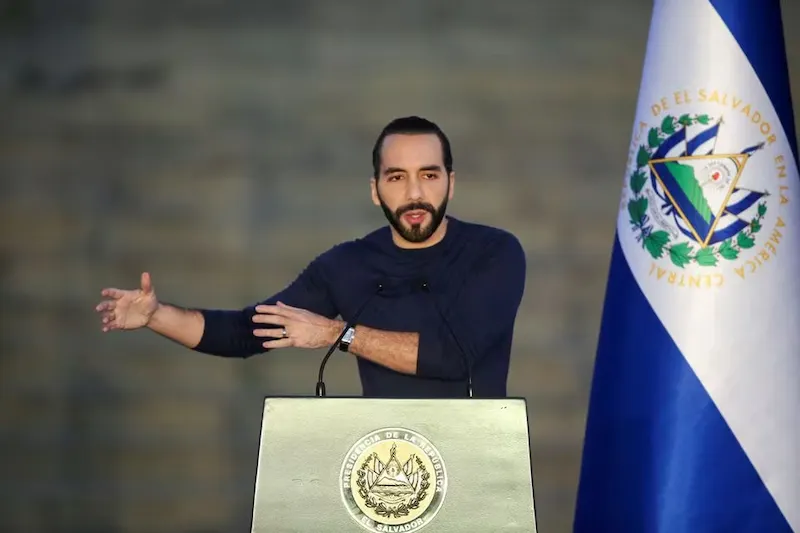


El Salvadorans took to the polls on Sunday in an election that is expected to secure another resounding victory for President Nayib Bukele. Despite concerns over his authoritarian tendencies, many voters are willing to overlook his drift as he successfully tackled gang violence, which had previously plagued the country. Bukele, at 42 years old, is set to become the first re-elected president in nearly a century.
Bukele has gained immense popularity by highlighting the success of his security strategy, in which civil liberties were temporarily suspended to apprehend over 75,000 Salvadorans without charges. This bold approach led to a significant decrease in the national murder rates and transformed El Salvador, a country with a populace of 6.3 million, from being one of the world's most dangerous nations to a safer place.
However, some analysts caution that this mass incarceration of approximately 1% of the population is not a sustainable long-term strategy. Nevertheless, polls indicate that voters are inclined to reward Bukele for his efforts in decimating the crime groups, which had made life unbearable in El Salvador and prompted waves of migration to the United States.
Victor Lopez, a 65-year-old construction worker, expressed his support for Bukele, stating, "We have to continue the positive changes happening in our country. We now have low crime rates, flourishing tourism, and other positive aspects." He added that it is crucial to prevent the return to power of corrupt individuals from the past, as it would impede the government's ongoing projects.
The election also features five other candidates, including representatives from the traditional parties Farabundo Marti National Liberation Front (FMLN) and Nationalist Republican Alliance (ARENA). These two parties had governed El Salvador for a total of 30 years until 2019. However, pre-election polls indicate limited support for the contenders from FMLN and ARENA. Voters seem disenchanted with the traditional politics characterized by violence and corruption.
Voting centers were adorned with Bukele's party color, cyan blue, and his supporters proudly wore shirts featuring his image. In contrast, there was a notable absence of support for the opposition. Roberto Hernandez, a 46-year-old accountant, affirmed, "The country has changed so much, and we don't want to go back to the past. I am happy to vote for him. The opposition finds itself in this situation due to its own actions."
While some voice concerns about Bukele's authoritarianism, many Salvadorans remain unfazed, with approximately 80% of them expressing their support for the president. Bukele has used his party's supermajority in the legislative assembly to reshape institutions and solidify his control over key sectors of the government. He also gained attention by introducing Bitcoin as legal tender, even drawing criticism from the International Monetary Fund (IMF).
Critics argue that El Salvador's democracy is under threat, but Bukele appears unfazed by such concerns. He once humorously referred to himself as the "world's coolest dictator" on his social media profile. His ability to tap into voters' discontent towards the former political parties has garnered him considerable support.
Assuming he secures re-election, Bukele's primary challenge will be the country's economy, which has been the slowest-growing in Central America during his tenure. Additionally, over a quarter of Salvadorans live in poverty. While some voters have emphasized this as a decisive factor, expressing concerns about the potential collapse of the economy and rising prices, Bukele's focus on economic issues will be crucial in his second term.
Bukele's ambitious plans for Bitcoin City, a tax-free cryptocurrency haven fueled by geothermal energy from a volcano, have not gained significant traction. Private investment has declined, and extreme poverty has doubled during his time in power. Moreover, the IMF, engaged in negotiations for a $1.3 billion bailout with El Salvador, has described the country's fiscal situation as "fragile."
As Salvadorans cast their votes, Bukele remains a dominant figure in the political landscape. Whether he can effectively address economic and democratic concerns in his second term will ultimately shape his legacy as the leader of El Salvador.